<?xml version="1.0" encoding="UTF-8"?>
<?xml-stylesheet type="text/xsl" media="screen" href="/~files/atom-premium.xsl"?>
                                                                                                                                                                                                                                                                                                                                                                                                                                                                                                                                             
<feed xmlns="http://www.w3.org/2005/Atom" xmlns:feedpress="https://feed.press/xmlns" xmlns:media="http://search.yahoo.com/mrss/" xmlns:podcast="https://podcastindex.org/namespace/1.0" xml:lang="en-US">
  <feedpress:locale>en</feedpress:locale>
  <link rel="hub" href="https://feedpress.superfeedr.com/"/>
  <id>tag:baymard.com,2005:/articles</id>
  <link rel="alternate" type="text/html" href="https://baymard.com"/>
  <link rel="self" type="application/atom+xml" href="https://feeds.baymard.com/baymard"/>
  <title>Baymard Institute</title>
  <updated>2026-08-13T10:01:00+02:00</updated>
  <entry>
    <id>tag:baymard.com,2005:Article/476</id>
    <published>2026-08-13T10:01:00+02:00</published>
    <updated>2026-08-13T10:11:08+02:00</updated>
    <link rel="alternate" type="text/html" href="https://feeds.baymard.com/link/9825/17417083/food-delivery-and-takeout-ux-benchmark-2026"/>
    <title>Food Delivery &amp; Takeout UX Benchmark: 3,100+ Performance Scores and 1,900+ Best Practice Examples</title>
    <content type="html"><![CDATA[<p><em>(Note: Unfortunately, e-mail and RSS don’t support advanced layouts and features. If the graphics in this article look strange, you may want to <a href="https://baymard.com/blog/food-delivery-and-takeout-ux-benchmark-2026">read the article</a> in your web browser.)</em></p>


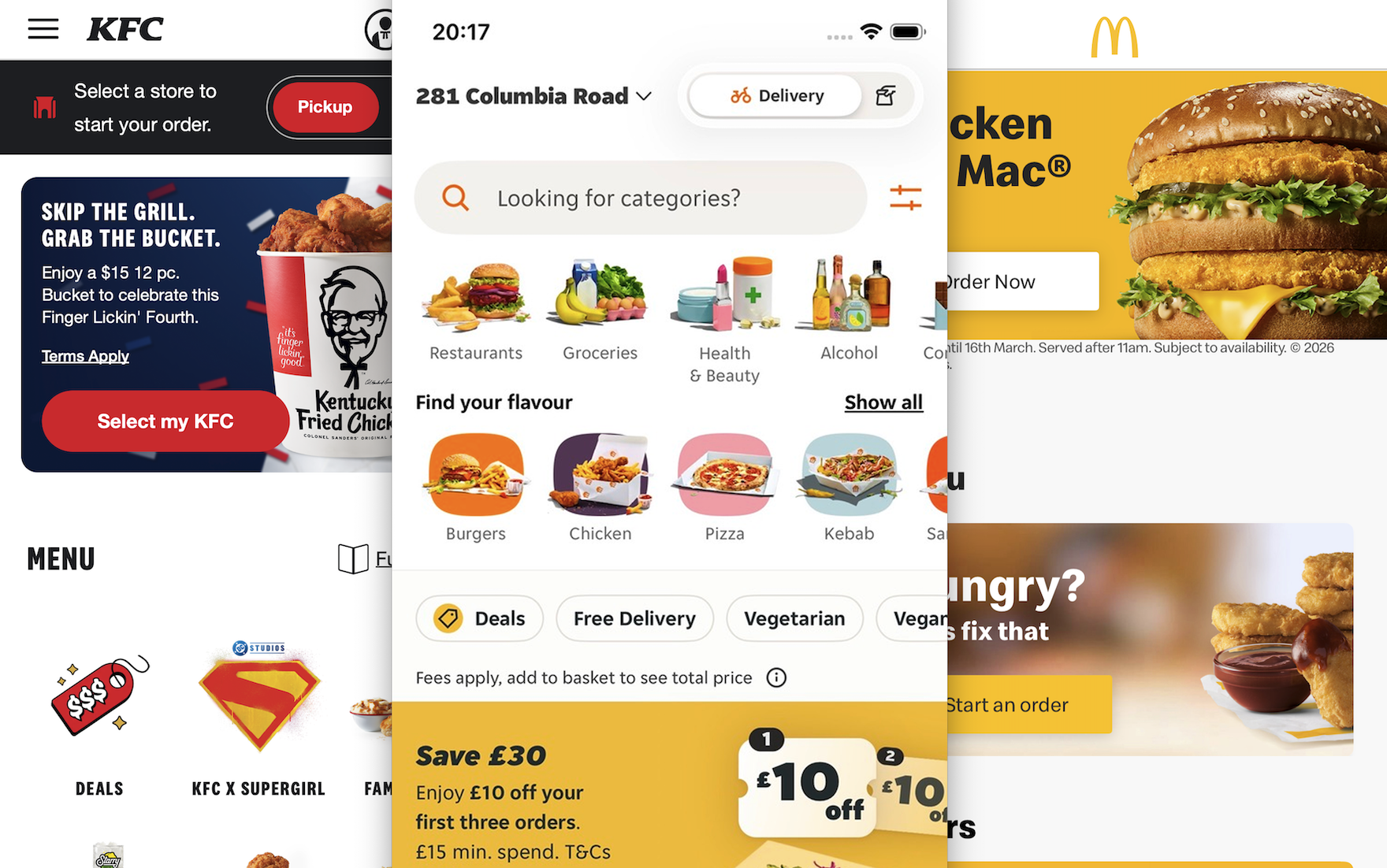
<div class="anecdote-graphic-dn32ja anecdote-module-3ba83n disable-zoom-kf4n8k v-size-big"><div class="inner"><div class="anecdote-intrinsic-embed-n42ha1"><div class="inner" style="padding-bottom: 62.61363636363636%;"><img alt="Three mobile homepages for KFC, Just Eat, and McDonalds." src="https://cdn.baymard.com/research/media_files/attachments/175668/original/research-media-file-aab6744645a803e77a9634b8893bb02c.png"></div></div></div></div>


<p>At Baymard, we’ve just released a new UX benchmark with <strong>8 “Food Delivery &amp; Takeout”</strong> UX case studies.</p>


<p>This follows our large-scale user testing on <a href="https://baymard.com/blog/food-delivery-takeout-launch">Food Delivery &amp; Takeout UX</a> and <strong>adds to</strong> our existing <a href="https://baymard.com/ux-benchmark">ecommerce UX benchmark</a>.</p>


<p>In this article, we give you a <strong>snapshot</strong> of the overall UX performance.</p>


<h2 id="8-food-delivery--takeout-ux-case-studies-and-the-overall-performance">8 Food Delivery &amp; Takeout UX Case Studies and the Overall Performance</h2>


<div class="anecdote-module-3ba83n v-size-full-width">
<div class="grid case-study-cards-yz73ak">

    <a class="card case-study-cards-yz73ak" href="https://baymard.com/ux-benchmark/case-studies/just-eat">

      <div class="card--section-top case-study-cards-yz73ak">
        <div class="card--title-with-perf case-study-cards-yz73ak">
          <h3 class="card--title case-study-cards-yz73ak">
            Just Eat
          </h3>
          <div class="card--performance case-study-cards-yz73ak">
            <p class="card--performance-pill case-study-cards-yz73ak" style="color: #e58c0d">
              mediocre
            </p>
          </div>
        </div>

          <p class="card--collections case-study-cards-yz73ak">
            <span class="card--collections-truncate case-study-cards-yz73ak">
              Food Delivery &amp; Takeout
            </span>
          </p>
      </div>

      <div class="card--section-bottom case-study-cards-yz73ak">
        <p class="card--page-designs case-study-cards-yz73ak">
          <span class="card--page-designs-prefix case-study-cards-yz73ak">
            49
            page designs:
          </span>
          mobile, app
        </p>
      </div>
        
</a>
    <a class="card case-study-cards-yz73ak" href="https://baymard.com/ux-benchmark/case-studies/kentucky-fried-chicken">

      <div class="card--section-top case-study-cards-yz73ak">
        <div class="card--title-with-perf case-study-cards-yz73ak">
          <h3 class="card--title case-study-cards-yz73ak">
            KFC
          </h3>
          <div class="card--performance case-study-cards-yz73ak">
            <p class="card--performance-pill case-study-cards-yz73ak" style="color: #e48a0d">
              mediocre
            </p>
          </div>
        </div>

          <p class="card--collections case-study-cards-yz73ak">
            <span class="card--collections-truncate case-study-cards-yz73ak">
              Food Delivery &amp; Takeout
            </span>
          </p>
      </div>

      <div class="card--section-bottom case-study-cards-yz73ak">
        <p class="card--page-designs case-study-cards-yz73ak">
          <span class="card--page-designs-prefix case-study-cards-yz73ak">
            48
            page designs:
          </span>
          mobile, app
        </p>
      </div>
        
</a>
    <a class="card case-study-cards-yz73ak" href="https://baymard.com/ux-benchmark/case-studies/uber-eats">

      <div class="card--section-top case-study-cards-yz73ak">
        <div class="card--title-with-perf case-study-cards-yz73ak">
          <h3 class="card--title case-study-cards-yz73ak">
            Uber Eats
          </h3>
          <div class="card--performance case-study-cards-yz73ak">
            <p class="card--performance-pill case-study-cards-yz73ak" style="color: #d46815">
              mediocre
            </p>
          </div>
        </div>

          <p class="card--collections case-study-cards-yz73ak">
            <span class="card--collections-truncate case-study-cards-yz73ak">
              Food Delivery &amp; Takeout
            </span>
          </p>
      </div>

      <div class="card--section-bottom case-study-cards-yz73ak">
        <p class="card--page-designs case-study-cards-yz73ak">
          <span class="card--page-designs-prefix case-study-cards-yz73ak">
            54
            page designs:
          </span>
          mobile, app
        </p>
      </div>
        
</a>
    <a class="card case-study-cards-yz73ak" href="https://baymard.com/ux-benchmark/case-studies/dominos-pizza">

      <div class="card--section-top case-study-cards-yz73ak">
        <div class="card--title-with-perf case-study-cards-yz73ak">
          <h3 class="card--title case-study-cards-yz73ak">
            Domino’s Pizza
          </h3>
          <div class="card--performance case-study-cards-yz73ak">
            <p class="card--performance-pill case-study-cards-yz73ak" style="color: #d16317">
              poor
            </p>
          </div>
        </div>

          <p class="card--collections case-study-cards-yz73ak">
            <span class="card--collections-truncate case-study-cards-yz73ak">
              Food Delivery &amp; Takeout
            </span>
          </p>
      </div>

      <div class="card--section-bottom case-study-cards-yz73ak">
        <p class="card--page-designs case-study-cards-yz73ak">
          <span class="card--page-designs-prefix case-study-cards-yz73ak">
            34
            page designs:
          </span>
          mobile, app
        </p>
      </div>
        
</a>
    <a class="card case-study-cards-yz73ak" href="https://baymard.com/ux-benchmark/case-studies/doordash">

      <div class="card--section-top case-study-cards-yz73ak">
        <div class="card--title-with-perf case-study-cards-yz73ak">
          <h3 class="card--title case-study-cards-yz73ak">
            DoorDash
          </h3>
          <div class="card--performance case-study-cards-yz73ak">
            <p class="card--performance-pill case-study-cards-yz73ak" style="color: #d16217">
              poor
            </p>
          </div>
        </div>

          <p class="card--collections case-study-cards-yz73ak">
            <span class="card--collections-truncate case-study-cards-yz73ak">
              Food Delivery &amp; Takeout
            </span>
          </p>
      </div>

      <div class="card--section-bottom case-study-cards-yz73ak">
        <p class="card--page-designs case-study-cards-yz73ak">
          <span class="card--page-designs-prefix case-study-cards-yz73ak">
            48
            page designs:
          </span>
          mobile, app
        </p>
      </div>
        
</a>
    <a class="card case-study-cards-yz73ak" href="https://baymard.com/ux-benchmark/case-studies/mcdonalds">

      <div class="card--section-top case-study-cards-yz73ak">
        <div class="card--title-with-perf case-study-cards-yz73ak">
          <h3 class="card--title case-study-cards-yz73ak">
            McDonald’s
          </h3>
          <div class="card--performance case-study-cards-yz73ak">
            <p class="card--performance-pill case-study-cards-yz73ak" style="color: #bf3e1f">
              poor
            </p>
          </div>
        </div>

          <p class="card--collections case-study-cards-yz73ak">
            <span class="card--collections-truncate case-study-cards-yz73ak">
              Food Delivery &amp; Takeout
            </span>
          </p>
      </div>

      <div class="card--section-bottom case-study-cards-yz73ak">
        <p class="card--page-designs case-study-cards-yz73ak">
          <span class="card--page-designs-prefix case-study-cards-yz73ak">
            39
            page designs:
          </span>
          mobile, app
        </p>
      </div>
        
</a>
    <a class="card case-study-cards-yz73ak" href="https://baymard.com/ux-benchmark/case-studies/deliveroo">

      <div class="card--section-top case-study-cards-yz73ak">
        <div class="card--title-with-perf case-study-cards-yz73ak">
          <h3 class="card--title case-study-cards-yz73ak">
            Deliveroo
          </h3>
          <div class="card--performance case-study-cards-yz73ak">
            <p class="card--performance-pill case-study-cards-yz73ak" style="color: #bb3422">
              poor
            </p>
          </div>
        </div>

          <p class="card--collections case-study-cards-yz73ak">
            <span class="card--collections-truncate case-study-cards-yz73ak">
              Food Delivery &amp; Takeout
            </span>
          </p>
      </div>

      <div class="card--section-bottom case-study-cards-yz73ak">
        <p class="card--page-designs case-study-cards-yz73ak">
          <span class="card--page-designs-prefix case-study-cards-yz73ak">
            53
            page designs:
          </span>
          mobile, app
        </p>
      </div>
        
</a>
    <a class="card case-study-cards-yz73ak" href="https://baymard.com/ux-benchmark/case-studies/burger-king">

      <div class="card--section-top case-study-cards-yz73ak">
        <div class="card--title-with-perf case-study-cards-yz73ak">
          <h3 class="card--title case-study-cards-yz73ak">
            Burger King
          </h3>
          <div class="card--performance case-study-cards-yz73ak">
            <p class="card--performance-pill case-study-cards-yz73ak" style="color: #b42625">
              broken
            </p>
          </div>
        </div>

          <p class="card--collections case-study-cards-yz73ak">
            <span class="card--collections-truncate case-study-cards-yz73ak">
              Food Delivery &amp; Takeout
            </span>
          </p>
      </div>

      <div class="card--section-bottom case-study-cards-yz73ak">
        <p class="card--page-designs case-study-cards-yz73ak">
          <span class="card--page-designs-prefix case-study-cards-yz73ak">
            41
            page designs:
          </span>
          mobile, app
        </p>
      </div>
        
</a>

    <div class="card v-cta case-study-cards-yz73ak">
      <h3 class="card--title case-study-cards-yz73ak">
        YourSite.com?
      </h3>
      <p class="card--cta-paragraph case-study-cards-yz73ak">
        Want to know how your site performs?
        <a href="https://baymard.com/research">Get Premium access</a> 
        to review your own site or have it 
        <a href="https://baymard.com/audits/site-element">audited</a> 
        by Baymard researchers.
      </p>
    </div>

</div>
</div>


<p>These are the 8 <strong>in-depth</strong> Food Delivery &amp; Takeout UX case studies.</p>


<p>The 8 mobile sites and apps have been manually assessed across <strong>390+ research-based UX parameters</strong> relevant to <a href="https://baymard.com/research/online-food-delivery">Food Delivery &amp; Takeout</a>, resulting in 3,100+ weighted UX performance scores and 1,900+ best practice examples from these mobile sites and apps.</p>


<p>Each of the 3,100+ <strong>UX performance scores</strong> from the 8 case studies is summarized in the interactive scatterplot below — showing you how they perform collectively and individually:</p>


<p>{{ scatterplot-graph: size=big + habitat=public + base-sites=collection:online-food-delivery + view-structure-id=gemini-st_l9jw5tjp }}</p>


<p>The <strong>overall UX</strong> performance of the Food Delivery &amp; Takeout sites and apps ranges from “poor” to “mediocre”.</p>


<p>What is missing is almost everything <strong>specific to this industry</strong>, rather than borrowed from general retail.</p>


<p><strong>Repeat ordering was undersupported</strong> despite its importance within the industry.</p>


<p>With no route to past orders from the homepage, and order histories too sparse to identify them by, one of the most common things a customer does here was also one of the <strong>least accommodated</strong>.</p>


<p><strong>Dietary and customization</strong> needs had no supported path at any decision point.</p>


<p>Category-specific filters were absent throughout and customization options went undescribed on the item page, leaving allergy and restriction constraints <strong>needlessly difficult</strong> to resolve.</p>


<p><strong>Orientation and return paths failed</strong> at every step of the ordering flow.</p>


<p>Scope markers, breadcrumbs, and back-paths were <strong>missing throughout</strong>, so going one level deeper meant losing any reliable way back out.</p>


<p>Furthermore, fulfillment timing and tipping were presented <strong>without the detail needed</strong> to commit.</p>


<p>For an ecommerce industry built on habitual reordering from a phone, often under time pressure and dietary constraint, these are <strong>not refinements</strong> but the substance of the task.</p>


<p>As this benchmark shows, with <strong>no sites</strong> delivering even a “decent” or better overall user experience, there is plenty of room for improvement.</p>


<p>A publicly available <strong>overview</strong> of the research and benchmark can be found on our <a href="https://baymard.com/research/online-food-delivery">Food Delivery &amp; Takeout UX research</a> overview page.</p>


<p><em><strong>Getting access:</strong> all 3,100+ UX performance scores, 1,900+ best practice examples, and the UX insights from researching the Food Delivery &amp; Takeout ecommerce industry are available immediately and in full within <a href="https://baymard.com/research">Baymard</a>. (If you already have access through an account, open the <a href="https://baymard.com/premium/benchmarks/collections/online-food-delivery">Food Delivery &amp; Takeout</a>.)</em></p>


<p><em>If you want to know how your food delivery or takeout mobile site and app performs and compare, then learn more about getting Baymard to conduct a <a href="https://baymard.com/audits/food-delivery-and-takeout">Food Delivery &amp; Takeout UX audit</a> of your site.</em></p>


<p>
  <a href="https://twitter.com/intent/tweet?text=Food+Delivery+%26amp%3B+Takeout+UX+Benchmark%3A+3%2C100%2B+Performance+Scores+and+1%2C900%2B+Best+Practice+Examples&amp;url=https://baymard.com/blog/food-delivery-and-takeout-ux-benchmark-2026&amp;via=Baymard&amp;related=Baymard,jamieappleseed,KiehnHolst">Post this article on X</a>
</p>

  <h3>Related articles</h3>
  <ul>
      <li><a href="https://baymard.com/blog/food-delivery-takeout-launch">3 High-Level UX Takeaways from 1100+ Hours of Testing Leading Food Delivery and Takeout Sites</a></li>
      <li><a href="https://baymard.com/blog/grocery-food-delivery-orders">Grocery and Food Delivery Site UX: Allow Users to Add “Past Purchases” to the Cart from the Homepage</a></li>
  </ul><img src="https://feeds.baymard.com/link/9825/17417083.gif" height="1" width="1"/>]]></content>
    <author>
      <name>Anders Nielsen</name>
    </author>
  </entry>
  <entry>
    <id>tag:baymard.com,2005:Article/473</id>
    <published>2026-08-04T10:21:00+02:00</published>
    <updated>2026-08-04T14:31:00+02:00</updated>
    <link rel="alternate" type="text/html" href="https://feeds.baymard.com/link/9825/17403157/ecommerce-quantitative-ux-insights-2026"/>
    <title>Ecommerce Quantitative UX: 3 High-Level Trends &amp; Takeaways from 20+ Charts</title>
    <content type="html"><![CDATA[<p><em>(Note: Unfortunately, e-mail and RSS don’t support advanced layouts and features. If the graphics in this article look strange, you may want to <a href="https://baymard.com/blog/ecommerce-quantitative-ux-insights-2026">read the article</a> in your web browser.)</em></p>


<div class="anecdote-graphic-dn32ja anecdote-module-3ba83n disable-zoom-kf4n8k v-size-big"><div class="inner"><div class="anecdote-intrinsic-embed-n42ha1"><div class="inner" style="padding-bottom: 61.19318181818182%;"><img alt="Bar chart and partially visible pie chart previewing the range of data covered in the general ecommerce quant study." src="https://cdn.baymard.com/research/media_files/attachments/174650/original/research-media-file-e5c0becaa0df48dc887c14b879b21610.png"></div></div></div></div>


<div class="anecdote-inception-ab2a8j anecdote-module-3ba83n accentuated-box--design-system-transition-fdh4he page-feature-abjgu anecdote-secondary-font-a3a8fb anecdote-small-text-size-an43ja"><div class="anecdote-wysicontent-ndj4ab inner">
<p class="overline--design-system-transition-fdh4he">Key Stats &amp; Takeaways</p>
<ul>
  <li>20+ new insights on general ecommerce shopper habits and preferences</li>
  <li>1,083 US online shoppers surveyed in this quantitative UX study</li>
  <li>General ecommerce shopping habits remain consistent overall, but a few noteworthy shifts stand out this year, from declining return frequencies to changing newsletter preferences</li>
</ul>
</div></div>


<p>At Baymard, we’ve released updated <a href="https://baymard.com/blog/quantitative-insights-launch">Quantitative Insights</a> into the habits and preferences of online shoppers across key ecommerce stages.</p>


<p>These insights are <strong>survey-based data visualizations</strong> that complement and deepen our large-scale <a href="https://baymard.com/research">UX research findings</a>.</p>


<p>The 20+ insights cover the <strong>online shopping experience</strong> across a wide range of topics: product discovery, cross-sell preferences, sale-seeking behaviors, checkout friction, return behaviors, account feature expectations, and newsletter management.</p>


<p>Ecommerce shoppers make decisions <strong>with deeply ingrained expectations</strong> regarding transparency, flexibility, and convenience, standards that continually evolve as the online shopping landscape evolves.</p>


<p>While the vast majority of our foundational data <strong>remains highly stable</strong> year after year, tracking this data over time reveals a few subtle, critical shifts in reported consumer habits.</p>


<p>Over the last 3 years, consumer habits show clear directional changes in <strong>how frequently shoppers make online returns</strong> for their past purchases.</p>


<p>Further down the funnel, they <strong>frequently leverage accounts</strong> to manage post-purchase utility, carefully balancing their participation in brand incentive structures with their tolerance for direct retailer outreach.</p>


<p>Each of <strong>these evolving dynamics</strong> plays out at a different stage of the user experience, highlighting exactly where optimization priorities should be re-evaluated.</p>


<p>In this article, we’ll highlight <strong>3 high-level findings</strong> that reflect the most notable shifts since our previous annual study:</p>


<ul>
  <li>Online return frequency among consumers has steadily declined over the last three years</li>
  <li>High email frequency from specific retailers has overtaken general inbox clutter as the top driver of newsletter unsubscribes</li>
  <li>Loyalty programs have climbed in priority, securing the fourth spot for online account expectations</li>
</ul>


<h2 id="online-return-frequency-among-consumers-has-steadily-declined-over-the-last-three-years">Online Return Frequency Among Consumers Has Steadily Declined Over the Last Three Years</h2>


<div class="anecdote-graphic-dn32ja anecdote-module-3ba83n"><div class="inner">
<div class="anecdote-intrinsic-embed-n42ha1"><div class="inner" style="padding-bottom: 91.64772727272728%;"><img alt="Pie chart showing how many online purchases shoppers estimate they return each year." src="https://cdn.baymard.com/research/media_files/attachments/174651/original/research-media-file-44e8cef1a346a0e107c9c96593887b7a.png"></div></div>
<div class="anecdote-caption-ajkd3b"><div class="inner anecdote-wysicontent-ndj4ab">
<p>While more than half of online consumers (52%) report making an online return in the past year, multi-year tracking shows a continuous drop in high-frequency return behaviors since 2024. (See <a href="https://baymard.com/premium/quant-insights/GC054?time_period=March+2026">Quantitative Insight #GC054</a> for an interactive version of this graph alongside key findings and actionable insights).</p>
</div></div>
</div></div>


<p>Online consumers exhibit a <strong>clear shift in their shopping habits</strong> as multi-year tracking reveals that frequent return rates are steadily declining.</p>


<p>Our latest study shows that <strong>52% of users</strong> say they have returned at least one item purchased online in the past 12 months, with 24% returning an item just once and 28% doing so more than once.</p>


<p>Interestingly, tracking these responses over time reveals that the segment of shoppers who say they return items more than once <strong>has steadily dropped</strong> from 44% in 2024, down to 34% in 2025, and hitting a low of 28% this year.</p>


<p>Adding to this, the percentage of online shoppers who report that they <strong>haven’t returned any items</strong> over the past year has climbed significantly, rising from 26% in 2024 up to 44% in our latest data.</p>


<p>This multi-year decline in return frequency suggests that either retailers’ optimization tools and smarter shopping habits are <strong>successfully minimizing incorrect purchases</strong>, or consumers are simply keeping wrong items to avoid the growing frustration with restrictive return windows and added fees.</p>


<p>From a strategic standpoint, it’s therefore critical to <strong>minimize any unnecessary friction</strong> by ensuring return policies are <a href="https://baymard.com/guidelines/1501-return-policy-readability">highly visible and easy to understand</a> before a user reaches checkout.</p>


<p>See <a href="https://baymard.com/premium/quant-insights/GC054?time_period=March+2026">Quantitative Insight #GC054</a> for an interactive version of this graph alongside key findings and actionable insights.</p>


<h2 id="retailer-overcommunication-becomes-the-leading-catalyst-for-newsletter-unsubscribes">Retailer Overcommunication Becomes the Leading Catalyst for Newsletter Unsubscribes</h2>


<div class="anecdote-graphic-dn32ja anecdote-module-3ba83n"><div class="inner">
<div class="anecdote-intrinsic-embed-n42ha1"><div class="inner" style="padding-bottom: 85.39772727272728%;"><img alt="Horizontal bar graph of newsletter unsubscribe reasons, featuring a tight cluster of top user complaints." src="https://cdn.baymard.com/research/media_files/attachments/174652/original/research-media-file-e3425aa1a4815e7f1346fcdd5952b3b8.png"></div></div>
<div class="anecdote-caption-ajkd3b"><div class="inner anecdote-wysicontent-ndj4ab">
<p>While overall inbox clutter remains a challenge, 48% of surveyed shoppers report unsubscribing because emails arrive too frequently from a single specific retailer. (See <a href="https://baymard.com/premium/quant-insights/GC056?time_period=March%202026">Quantitative Insight #GC056</a> for an interactive version of this graph alongside key findings and actionable insights).</p>
</div></div>
</div></div>


<p>While marketing newsletters remain <strong>highly critical customer retention channels</strong>, overcommunicating can quickly alienate an engaged audience.</p>


<p>The primary driver of customer churn has shifted since our last study, as 48% of users now say they choose to unsubscribe because marketing emails simply come <strong>too often from a specific retailer</strong>.</p>


<p>General inbox saturation follows closely behind on the chart, with 46% of respondents reporting that they <strong>receive too many newsletter emails in general</strong> across the collective volume of brands they follow.</p>


<p>Adding to this, content quality continues to heavily influence audience retention, given that 44% of users report unsubscribing because they ultimately <strong>lose interest in the newsletter content</strong> itself.</p>


<p>This inversion of the top two choices demonstrates that consumers are becoming less tolerant of high-frequency cadences from individual brands, <strong>making individual cadence management a higher priority</strong> than general email volume.</p>


<p>From a strategic standpoint, it’s therefore important to move away from binary all-or-nothing opt-outs and instead <strong>let users <a href="https://baymard.com/guidelines/908-customizing-newsletter-emails-by-frequency-and-topic">control email frequency</a></strong> through granular cadence adjustments in a dedicated preference center.</p>


<p>See <a href="https://baymard.com/premium/quant-insights/GC056?time_period=March%202026">Quantitative Insight #GC056</a> for an interactive version of this graph alongside key findings and actionable insights.</p>


<h2 id="loyalty-program-shifts-upward-in-account-feature-priorities">Loyalty Program Shifts Upward in Account Feature Priorities</h2>


<div class="anecdote-graphic-dn32ja anecdote-module-3ba83n"><div class="inner">
<div class="anecdote-intrinsic-embed-n42ha1"><div class="inner" style="padding-bottom: 124.60227272727273%;"><img alt="Horizontal bar chart showing the most important features when accessing an online customer account." src="https://cdn.baymard.com/research/media_files/attachments/174653/original/research-media-file-b6904cbe78125711309a57a2df79b60d.png"></div></div>
<div class="anecdote-caption-ajkd3b"><div class="inner anecdote-wysicontent-ndj4ab">
<p>While order tracking remains the dominant priority for 51% of shoppers, 24% say loyalty programs are a high-priority feature, moving it up into the fourth spot overall. (See <a href="https://baymard.com/premium/quant-insights/GC051?time_period=March%202026">Quantitative Insight #GC051</a> for an interactive version of this graph alongside key findings and actionable insights).</p>
</div></div>
</div></div>


<p>Shoppers continue to view <a href="https://baymard.com/blog/current-state-accounts-selfservice">customer accounts</a> primarily as <strong>hubs for post-purchase utility</strong>, but their relative feature priorities are changing.</p>


<p>As expected, logistical tracking remains the highest-priority requirement, with <strong>51% of respondents</strong> saying that checking order status or delivery tracking is one of the most important account features an ecommerce site can offer.</p>


<p>Additionally, managing payment options outside the checkout flow remains vital, with <strong>30% of shoppers</strong> reporting that they want the ability to maintain their saved credit cards independently, while <strong>26% prioritize</strong> reviewing past order history.</p>


<p>When looking closely at this chart, the most notable shift from last year is that <strong>24% of users</strong> now report that <a href="https://baymard.com/blog/loyalty-program-ux-launch">loyalty programs</a> are a high-priority account feature, reflecting its steady increase in importance to online consumers.</p>


<p>This indicates that post-purchase dashboards serve an <strong>increasingly valuable secondary purpose</strong> as a centralized portal for managing brand incentives and ongoing rewards status.</p>


<p>To align with this <strong>shifting user expectation</strong>, ecommerce platforms should ensure that <a href="https://baymard.com/guidelines/2985-earned-points-on-order-details-pages">loyalty point balances</a>, <a href="https://baymard.com/guidelines/3141-showing-a-history-of-users-points-earning-and-redemption">point earning history</a>, and available rewards are <a href="https://baymard.com/guidelines/3153-showing-points-and-rewards-balances-on-loyalty-programs-apps-or-mobile-homepages">integrated directly</a> into the main account dashboard view rather than buried in secondary submenus.</p>


<p>See <a href="https://baymard.com/premium/quant-insights/GC051?time_period=March%202026">Quantitative Insight #GC051</a> for an interactive version of this graph alongside key findings and actionable insights.</p>


<h2 id="20-quantitative-insights-to-inform-general-ecommerce-ux-improvements">20+ Quantitative Insights to Inform General Ecommerce UX Improvements</h2>


<div class="anecdote-graphic-dn32ja anecdote-module-3ba83n v-size-big"><div class="inner">
<div class="anecdote-intrinsic-embed-n42ha1"><div class="inner" style="padding-bottom: 66.25%;"><img alt='"Quantitative Insights" list page with filtering drop-downs above 3 visible general ecommerce insights cards.' src="https://cdn.baymard.com/research/media_files/attachments/174654/original/research-media-file-0bb0fd78aa0c9ab617bde31a465b3cc3.png"></div></div>
<div class="anecdote-caption-ajkd3b"><div class="inner anecdote-wysicontent-ndj4ab">
<p>In addition to the 3 insights presented here, all 20+ general ecommerce UX survey insights are available on Baymard along with our Quantitative Insights for Loyalty and other industry-specific studies.</p>
</div></div>
</div></div>


<p>These are <strong>just 3</strong> of the insights from our <a href="https://baymard.com/premium/quant-insights?studyIds=3%2C7%2C6">general ecommerce quantitative study</a>.</p>


<p>Explore the full set of insights to build an <strong>in-depth picture</strong> of how general ecommerce shoppers behave and what they expect online.</p>


<p>Pair these insights with our <a href="https://baymard.com/product/ux-best-practice-guidelines">700+ UX guidelines</a> based on observed user behavior to <strong>ground your UX design decisions</strong> in both behavioral research and survey data.</p>


<p>Note that we also offer <strong>industry-specific Quantitative Insights</strong> for <a href="https://baymard.com/blog/flight-booking-and-airlines-quantitative-ux-insights-2026">Flight Booking &amp; Airlines</a>, <a href="https://baymard.com/blog/apparel-and-accessories-quantitative-ux-insights-2026">Apparel &amp; Accessories</a>, <a href="https://baymard.com/blog/furniture-and-home-decor-quantitative-ux-insights-2026">Furniture &amp; Home Decor</a>, and <a href="https://baymard.com/blog/home-and-hardware-quantitative-ux-insights">Home &amp; Hardware</a> ecommerce shoppers.</p>


<p><em><strong>Getting access:</strong> all 20+ general ecommerce quantitative insights are available now within <a href="https://baymard.com/research">Baymard</a>. (Already have an account? Go directly to the <a href="https://baymard.com/premium/quant-insights?studyIds=3%2C7%2C6">general ecommerce quantitative study</a>).</em></p>


<p><em>To find out how your ecommerce desktop site, mobile site, or app performs against industry benchmarks, learn more about a Baymard <a href="https://baymard.com/ux-audit-services">UX audit</a> of your site or app.</em></p>


<p>
  <a href="https://twitter.com/intent/tweet?text=Ecommerce+Quantitative+UX%3A+3+High-Level+Trends+%26amp%3B+Takeaways+from+20%2B+Charts&amp;url=https://baymard.com/blog/ecommerce-quantitative-ux-insights-2026&amp;via=Baymard&amp;related=Baymard,jamieappleseed,KiehnHolst">Post this article on X</a>
</p>

  <h3>Related articles</h3>
  <ul>
      <li><a href="https://baymard.com/blog/quantitative-insights-launch">Introducing a New Baymard Research Focus: Quantitative Insights</a></li>
      <li><a href="https://baymard.com/blog/apparel-and-accessories-quantitative-ux-insights-2026">Apparel &amp; Accessories Quantitative UX: 3 High-Level Takeaways from 40+ Charts</a></li>
      <li><a href="https://baymard.com/blog/flight-booking-and-airlines-quantitative-ux-insights-2026">Flight Booking &amp; Airlines Quantitative UX: 3 High-Level Takeaways from 30+ Charts</a></li>
      <li><a href="https://baymard.com/blog/furniture-and-home-decor-quantitative-ux-insights-2026">Furniture &amp; Home Decor Quantitative UX: 3 High-Level Takeaways from 30+ Charts</a></li>
      <li><a href="https://baymard.com/blog/home-and-hardware-quantitative-ux-insights">Home &amp; Hardware Quantitative UX: 3 High-Level Takeaways from 30+ Charts of Key Findings and Actionable Insights</a></li>
      <li><a href="https://baymard.com/blog/loyalty-program-ux-launch">Announcing Baymard’s New Theme: Loyalty Program UX</a></li>
      <li><a href="https://baymard.com/blog/current-state-product-list-and-filtering">Product List UX 2025: 8 Common Pitfalls &amp; Best Practices (80% Have Serious Issues)</a></li>
      <li><a href="https://baymard.com/blog/ecommerce-navigation-best-practice">Homepage and Category Navigation UX 2025: 67% of Mobile Sites Have Mediocre-to-Poor Performance</a></li>
      <li><a href="https://baymard.com/blog/current-state-accounts-selfservice">Accounts &amp; Self-Service UX 2025: 5 Common Pitfalls &amp; Best Practices</a></li>
      <li><a href="https://baymard.com/blog/mobile-ux-ecommerce">Mobile UX Trends 2026: 10 Best Practices</a></li>
      <li><a href="https://baymard.com/blog/desktop-ux-ecommerce">Desktop UX Trends: 10 Common Pitfalls &amp; Best Practices</a></li>
      <li><a href="https://baymard.com/blog/mobile-app-ux-trends">Mobile App UX Trends: The Current State of Ecommerce App UX (11 Common Pitfalls &amp; Best Practices)</a></li>
      <li><a href="https://baymard.com/blog/current-state-ecommerce-product-page-ux">Product Page UX 2026: 10 Pitfalls and Best Practices</a></li>
      <li><a href="https://baymard.com/blog/current-state-of-checkout-ux">Checkout UX 2025: 10 Pitfalls and Best Practices</a></li>
      <li><a href="https://baymard.com/blog/ecommerce-search-query-types">Ecommerce Search UX 2026: 8 Search “Query Types” UX Best Practices (56% of Sites Have Issues)</a></li>
  </ul><img src="https://feeds.baymard.com/link/9825/17403157.gif" height="1" width="1"/>]]></content>
    <author>
      <name>Anja Feibel Meerwald</name>
    </author>
  </entry>
  <entry>
    <id>tag:baymard.com,2005:Article/474</id>
    <published>2026-07-28T07:27:00+02:00</published>
    <updated>2026-08-12T11:08:29+02:00</updated>
    <link rel="alternate" type="text/html" href="https://feeds.baymard.com/link/9825/17390037/internet-service-providers-ux-benchmark-2026"/>
    <title>Internet Service Providers UX Benchmark: 1,700+ Performance Scores and 1,100+ Best Practice Examples</title>
    <content type="html"><![CDATA[<p><em>(Note: Unfortunately, e-mail and RSS don’t support advanced layouts and features. If the graphics in this article look strange, you may want to <a href="https://baymard.com/blog/internet-service-providers-ux-benchmark-2026">read the article</a> in your web browser.)</em></p>


<div class="anecdote-graphic-dn32ja anecdote-module-3ba83n disable-zoom-kf4n8k v-size-big"><div class="inner"><div class="anecdote-intrinsic-embed-n42ha1"><div class="inner" style="padding-bottom: 58.97727272727272%;"><img alt="Frontier desktop homepage advertising “Fiber 5 Gig Internet Is Here” with address lookup feature below." src="https://cdn.baymard.com/research/media_files/attachments/174843/original/research-media-file-d0d49b906d4554969c770f982adb9ea4.png"></div></div></div></div>


<p>At Baymard, we’ve just released a new UX benchmark with <strong>7 “Internet Service Providers (ISP)”</strong> UX case studies.</p>


<p>This follows from our large-scale user testing and <strong>adds to</strong> our existing <a href="https://baymard.com/ux-benchmark">ecommerce UX benchmark</a>.</p>


<p>In this article, we give you a <strong>snapshot</strong> of the overall UX performance.</p>


<h2 id="7-internet-service-providers-ux-case-studies-and-the-overall-performance">7 Internet Service Providers UX Case Studies and the Overall Performance</h2>


<div class="anecdote-module-3ba83n v-size-full-width">
<div class="grid case-study-cards-yz73ak">

    <a class="card case-study-cards-yz73ak" href="https://baymard.com/ux-benchmark/case-studies/bt">

      <div class="card--section-top case-study-cards-yz73ak">
        <div class="card--title-with-perf case-study-cards-yz73ak">
          <h3 class="card--title case-study-cards-yz73ak">
            BT
          </h3>
          <div class="card--performance case-study-cards-yz73ak">
            <p class="card--performance-pill case-study-cards-yz73ak" style="color: #ea970a">
              mediocre
            </p>
          </div>
        </div>

          <p class="card--collections case-study-cards-yz73ak">
            <span class="card--collections-truncate case-study-cards-yz73ak">
              Internet Service Providers
            </span>
          </p>
      </div>

      <div class="card--section-bottom case-study-cards-yz73ak">
        <p class="card--page-designs case-study-cards-yz73ak">
          <span class="card--page-designs-prefix case-study-cards-yz73ak">
            26
            page designs:
          </span>
          desktop, mobile
        </p>
      </div>
        
</a>
    <a class="card case-study-cards-yz73ak" href="https://baymard.com/ux-benchmark/case-studies/telekom">

      <div class="card--section-top case-study-cards-yz73ak">
        <div class="card--title-with-perf case-study-cards-yz73ak">
          <h3 class="card--title case-study-cards-yz73ak">
            Telekom
          </h3>
          <div class="card--performance case-study-cards-yz73ak">
            <p class="card--performance-pill case-study-cards-yz73ak" style="color: #e9950b">
              mediocre
            </p>
          </div>
        </div>

          <p class="card--collections case-study-cards-yz73ak">
            <span class="card--collections-truncate case-study-cards-yz73ak">
              Internet Service Providers
            </span>
          </p>
      </div>

      <div class="card--section-bottom case-study-cards-yz73ak">
        <p class="card--page-designs case-study-cards-yz73ak">
          <span class="card--page-designs-prefix case-study-cards-yz73ak">
            35
            page designs:
          </span>
          desktop, mobile
        </p>
      </div>
        
</a>
    <a class="card case-study-cards-yz73ak" href="https://baymard.com/ux-benchmark/case-studies/frontier">

      <div class="card--section-top case-study-cards-yz73ak">
        <div class="card--title-with-perf case-study-cards-yz73ak">
          <h3 class="card--title case-study-cards-yz73ak">
            Frontier
          </h3>
          <div class="card--performance case-study-cards-yz73ak">
            <p class="card--performance-pill case-study-cards-yz73ak" style="color: #e9950b">
              mediocre
            </p>
          </div>
        </div>

          <p class="card--collections case-study-cards-yz73ak">
            <span class="card--collections-truncate case-study-cards-yz73ak">
              Internet Service Providers
            </span>
          </p>
      </div>

      <div class="card--section-bottom case-study-cards-yz73ak">
        <p class="card--page-designs case-study-cards-yz73ak">
          <span class="card--page-designs-prefix case-study-cards-yz73ak">
            25
            page designs:
          </span>
          desktop, mobile
        </p>
      </div>
        
</a>
    <a class="card case-study-cards-yz73ak" href="https://baymard.com/ux-benchmark/case-studies/cox">

      <div class="card--section-top case-study-cards-yz73ak">
        <div class="card--title-with-perf case-study-cards-yz73ak">
          <h3 class="card--title case-study-cards-yz73ak">
            COX
          </h3>
          <div class="card--performance case-study-cards-yz73ak">
            <p class="card--performance-pill case-study-cards-yz73ak" style="color: #e68f0c">
              mediocre
            </p>
          </div>
        </div>

          <p class="card--collections case-study-cards-yz73ak">
            <span class="card--collections-truncate case-study-cards-yz73ak">
              Internet Service Providers
            </span>
          </p>
      </div>

      <div class="card--section-bottom case-study-cards-yz73ak">
        <p class="card--page-designs case-study-cards-yz73ak">
          <span class="card--page-designs-prefix case-study-cards-yz73ak">
            24
            page designs:
          </span>
          desktop, mobile
        </p>
      </div>
        
</a>
    <a class="card case-study-cards-yz73ak" href="https://baymard.com/ux-benchmark/case-studies/centurylink">

      <div class="card--section-top case-study-cards-yz73ak">
        <div class="card--title-with-perf case-study-cards-yz73ak">
          <h3 class="card--title case-study-cards-yz73ak">
            CenturyLink
          </h3>
          <div class="card--performance case-study-cards-yz73ak">
            <p class="card--performance-pill case-study-cards-yz73ak" style="color: #dd7b11">
              mediocre
            </p>
          </div>
        </div>

          <p class="card--collections case-study-cards-yz73ak">
            <span class="card--collections-truncate case-study-cards-yz73ak">
              Internet Service Providers
            </span>
          </p>
      </div>

      <div class="card--section-bottom case-study-cards-yz73ak">
        <p class="card--page-designs case-study-cards-yz73ak">
          <span class="card--page-designs-prefix case-study-cards-yz73ak">
            25
            page designs:
          </span>
          desktop, mobile
        </p>
      </div>
        
</a>
    <a class="card case-study-cards-yz73ak" href="https://baymard.com/ux-benchmark/case-studies/viasat">

      <div class="card--section-top case-study-cards-yz73ak">
        <div class="card--title-with-perf case-study-cards-yz73ak">
          <h3 class="card--title case-study-cards-yz73ak">
            Viasat
          </h3>
          <div class="card--performance case-study-cards-yz73ak">
            <p class="card--performance-pill case-study-cards-yz73ak" style="color: #d66d14">
              mediocre
            </p>
          </div>
        </div>

          <p class="card--collections case-study-cards-yz73ak">
            <span class="card--collections-truncate case-study-cards-yz73ak">
              Internet Service Providers
            </span>
          </p>
      </div>

      <div class="card--section-bottom case-study-cards-yz73ak">
        <p class="card--page-designs case-study-cards-yz73ak">
          <span class="card--page-designs-prefix case-study-cards-yz73ak">
            32
            page designs:
          </span>
          desktop, mobile
        </p>
      </div>
        
</a>
    <a class="card case-study-cards-yz73ak" href="https://baymard.com/ux-benchmark/case-studies/charter-spectrum">

      <div class="card--section-top case-study-cards-yz73ak">
        <div class="card--title-with-perf case-study-cards-yz73ak">
          <h3 class="card--title case-study-cards-yz73ak">
            Spectrum
          </h3>
          <div class="card--performance case-study-cards-yz73ak">
            <p class="card--performance-pill case-study-cards-yz73ak" style="color: #d46815">
              mediocre
            </p>
          </div>
        </div>

          <p class="card--collections case-study-cards-yz73ak">
            <span class="card--collections-truncate case-study-cards-yz73ak">
              Internet Service Providers
            </span>
          </p>
      </div>

      <div class="card--section-bottom case-study-cards-yz73ak">
        <p class="card--page-designs case-study-cards-yz73ak">
          <span class="card--page-designs-prefix case-study-cards-yz73ak">
            15
            page designs:
          </span>
          desktop, mobile
        </p>
      </div>
        
</a>

    <div class="card v-cta case-study-cards-yz73ak">
      <h3 class="card--title case-study-cards-yz73ak">
        YourSite.com?
      </h3>
      <p class="card--cta-paragraph case-study-cards-yz73ak">
        Want to know how your site performs?
        <a href="https://baymard.com/research">Get Premium access</a> 
        to review your own site or have it 
        <a href="https://baymard.com/audits/site-element">audited</a> 
        by Baymard researchers.
      </p>
    </div>

</div>
</div>


<p>These are the 7 <strong>in-depth</strong> ISP UX case studies.</p>


<p>The 7 ISP sites have been manually assessed across <strong>280+ research-based UX parameters</strong> relevant to <a href="https://baymard.com/research/internet-service-providers">Internet Service Providers</a>, resulting in 1,700+ weighted UX performance scores and 1,100+ best practice examples from these desktop and mobile sites.</p>


<p>Each of the 1,700+ <strong>UX performance scores</strong> from the 7 ISP case studies is summarized in the interactive scatterplot below — showing you how they perform collectively and individually:</p>


<p>{{ scatterplot-graph: size=big + habitat=public + base-sites=collection:internet-service-providers + view-structure-id=gemini-st_9en1b7zd }}</p>


<p>The <strong>overall UX</strong> performance of the ISP sites is “mediocre,” with 1 site just on the border of “poor”.</p>


<p>ISP sites typically offer a narrow set of services, but these services come with complex eligibility rules and layered cost structures — placing <strong>added pressure</strong> on clarity and structure throughout the user journey.</p>


<p>Most sites provided strong initial navigation and product descriptions, but many <strong>failed to support decision-making</strong> where it mattered most: in the Plan Matrix and during application.</p>


<p>The Plan Matrix, <strong>a critical comparison tool</strong>, was frequently hindered by dense layouts, missing feature links, and a lack of supporting tools like FAQs or live chat.</p>


<p>Meanwhile, the application flow <strong>often broke down</strong> due to vague pricing, unclear progress indicators, and form-level friction.</p>


<p>Collectively, <strong>these issues undermined</strong> users’ ability to confidently select and apply for services, despite the relatively small product catalog.</p>


<p>For most ISP sites, improving clarity, guidance, and transparency in these high-stakes areas <strong>would yield significant UX gains</strong>.</p>


<p>As this benchmark shows, with <strong>no sites</strong> delivering even a “decent” or better overall user experience, there is plenty of room for improvement.</p>


<p>A publicly available <strong>overview</strong> of the research and benchmark can be found on our <a href="https://baymard.com/research/internet-service-providers">Internet Service Providers UX research</a> overview page.</p>


<p><em><strong>Getting access:</strong> all 1,700+ UX performance scores, 1,100+ best practice examples, and the UX insights from researching the Internet Service Providers ecommerce industry are available immediately and in full within <a href="https://baymard.com/research">Baymard</a>. (If you already have access through an account, open the <a href="https://baymard.com/premium/benchmarks/collections/internet-service-providers">Internet Service Providers UX Benchmark collection</a>.)</em></p>


<p><em>If you want to know how your ISP desktop and mobile sites perform and compare, then learn more about getting Baymard to conduct a <a href="https://baymard.com/audits/internet-service-providers">Internet Service Providers UX audit</a> of your site.</em></p>


<p>
  <a href="https://twitter.com/intent/tweet?text=Internet+Service+Providers+UX+Benchmark%3A+1%2C700%2B+Performance+Scores+and+1%2C100%2B+Best+Practice+Examples&amp;url=https://baymard.com/blog/internet-service-providers-ux-benchmark-2026&amp;via=Baymard&amp;related=Baymard,jamieappleseed,KiehnHolst">Post this article on X</a>
</p>

  <h3>Related articles</h3>
  <ul>
      <li><a href="https://baymard.com/blog/telco-ux-research">New Telco UX Research: 3 High-Level Takeaways from 3,500 Hours of Testing</a></li>
      <li><a href="https://baymard.com/blog/2021-telco-benchmark">17 Common UX Pitfalls Telco Websites Suffer From</a></li>
  </ul><img src="https://feeds.baymard.com/link/9825/17390037.gif" height="1" width="1"/>]]></content>
    <author>
      <name>Anders Nielsen</name>
    </author>
  </entry>
  <entry>
    <id>tag:baymard.com,2005:Article/472</id>
    <published>2026-06-30T13:45:00+02:00</published>
    <updated>2026-07-01T13:54:40+02:00</updated>
    <link rel="alternate" type="text/html" href="https://feeds.baymard.com/link/9825/17370265/ux-research-cost-saving-calculator"/>
    <title>Time is Money: How Pre-Validated UX Research Protects Your Resources &amp; Budget</title>
    <content type="html"><![CDATA[<p><em>(Note: Unfortunately, e-mail and RSS don’t support advanced layouts and features. If the graphics in this article look strange, you may want to <a href="https://baymard.com/blog/ux-research-cost-saving-calculator">read the article</a> in your web browser.)</em></p>


<div class="anecdote-graphic-dn32ja anecdote-module-3ba83n disable-zoom-kf4n8k v-size-big"><div class="inner"><div class="anecdote-intrinsic-embed-n42ha1"><div class="inner" style="padding-bottom: 56.76136363636364%;"><img alt="Cost-savings calculation with a breakdown of in-house research costs compared to subscribing to Baymard’s research." src="https://cdn.baymard.com/research/media_files/attachments/173995/original/research-media-file-2dc2695bf7c30a655371a9118bcee5ea.png"></div></div></div></div>


<p>When you try to prove the value of your design decisions, you often hit a wall. To back up your designs confidently, <strong>you need robust usability research</strong>.</p>


<p>But conducting that research yourself for every minor UI change or UX decision is <strong>expensive and time-consuming</strong>.</p>


<p>Baymard’s pre-validated research gives teams like yours access to <strong>established UX best practices</strong> in an instant, which helps you ship designs faster, more confidently, and protects your costs by reducing the research overheads.</p>


<p>To demonstrate that value, <strong>we’ve created a calculator</strong> that shows how a Baymard subscription helps you move faster and keep your UX research costs down.</p>


<p><strong>Note:</strong> <em>This calculator demonstrates initial cost savings based on consuming Baymard’s insights versus running new user research yourself. Baymard users typically see further value realizations from implementing those insights and improving website user experience and conversion rates.</em></p>


<h2 id="the-hidden-cost-of-your-in-house-user-research">The Hidden Cost of Your In-House User Research</h2>


<p>It’s easy to <strong>fall into the trap</strong> of thinking: <em>“We can just replicate this research in-house for less cost.”</em></p>


<p>But when you try to build everything <strong>from scratch</strong> without access to pre-validated <a href="https://baymard.com/product">UX insights</a>, your team quickly runs into three major roadblocks:</p>


<ul>
  <li>
<strong>You move slower:</strong> Your product teams lose momentum and your project timelines stretch out because you are forced to conduct research from scratch</li>
  <li>
<strong>You risk harming conversions:</strong> When timelines get tight, you risk making critical UX decisions based on gut feelings, which can ultimately harm your conversion rates</li>
  <li>
<strong>You spend more money:</strong> To keep up with research demands, you end up spending vastly more on external agency services or expanding your internal headcount just to conduct baseline testing</li>
</ul>


<h2 id="what-it-actually-costs-you-to-produce-a-ux-insight">What It Actually Costs You to Produce a UX Insight</h2>


<p>To protect your resources, you need to shift the focus away from what a research subscription costs, and <strong>instead look at how much you save by having instant access to prevalidated, ready-to-go UX research</strong>.</p>


<p>Let’s look at the math. To produce a single standard moderated usability study with 15 participants, your team will spend an average of <strong>55 hours of labor</strong> to plan, execute, and analyze it.</p>


<p>When you factor in regional hourly labor rates and participant incentives (around $85 per person in the UK and Europe; $100 per person in the US), <strong>the true cost</strong> of generating your own insights becomes clear:</p>


<div class="anecdote-graphic-dn32ja anecdote-module-3ba83n v-size-big"><div class="inner"><div class="anecdote-intrinsic-embed-n42ha1"><div class="inner" style="padding-bottom: 45.85227272727273%;"><img alt="Table showing a breakdown of cost per UX insight segmented by region (UK/Europe and US)." src="https://cdn.baymard.com/research/media_files/attachments/173996/original/research-media-file-9945e6a540cb8f7466164a428dc4d3f4.png"></div></div></div></div>


<p><strong>To generate a single UX insight, the cost is $362 in the US, and $262 in the UK and Europe.</strong></p>


<p><strong>Note:</strong> <em>These calculations focus strictly on your cost of producing the research itself (Labor Hours × Cost Per Hour + Incentives, divided by an average of 15 insights generated per study). This specific calculation does not address the value of implementing the insights (like your conversion rate uplift), but focuses entirely on what you save by bypassing bespoke research.</em></p>


<h2 id="what-cost-savings-do-key-ecommerce-industries-see">What Cost Savings Do Key Ecommerce Industries See?</h2>


<p>Our calculator shows that the average ecommerce business (across 35+ industries) realizes up to <strong>715% in net savings</strong> with a Baymard subscription, compared to the equivalent in-house research cost.</p>


<p>Here are the <strong>average number</strong> of insights consumed across the average ecommerce site from several key industries:</p>


<ul>
  <li>Retail <strong>~60</strong> unique insights consumed per year</li>
  <li>Apparel &amp; Fashion <strong>~53</strong> unique insights consumed per year</li>
  <li>Automotive <strong>~44</strong> unique insights consumed per year</li>
  <li>Finance <strong>~49</strong> unique insights consumed per year</li>
  <li>Health &amp; Wellness <strong>~48</strong> unique insights consumed per year</li>
  <li>Telco <strong>~55</strong> unique insights consumed per year</li>
  <li>Travel <strong>~52</strong> unique insights consumed per year</li>
</ul>


<h2 id="discover-your-tailored-cost-savings">Discover Your Tailored Cost Savings</h2>


<p>To <strong>help you calculate</strong> exactly how much your specific organization can save, we have developed a Baymard cost-savings calculator.</p>


<p>Instead of guessing, we use <strong>real-world data</strong> from over 1,200 accounts across various industries to map out your exact financial baseline.</p>


<p>To keep the data credible, we <strong>only track <em>unique</em> insights</strong> consumed within an account — requiring a team member to spend a minimum of 45 seconds on an insight for it to count toward your savings.</p>


<p>If the same insight is visited again, it won’t count again, which helps to keep the saving calculation conservative and <strong>reliable</strong>.</p>


<p>Depending on where you are in <strong>your UX journey</strong>, we can map out two distinct scenarios for you.</p>


<h3 id="if-you-are-new-to-baymards-research">If You Are New to Baymard’s Research</h3>


<p>We will <strong>calculate</strong> the average unique insights you need to leverage in year one to completely break even.</p>


<p>You will see the exact equivalent cost of trying to build that research in-house, alongside your <strong>projected annual net savings</strong> and net savings percentage.</p>


<h3 id="if-you-are-an-existing-baymard-customer">If You Are an Existing Baymard Customer</h3>


<p>We will <strong>calculate</strong> the average unique insights you need to leverage in year one to completely break even.</p>


<p>You will see the exact equivalent cost of trying to build that research in-house, plus a definitive look at the <strong>net savings and cost savings you have already realized</strong> to date.</p>


<p>This gives you <strong>the exact data you need</strong> to confidently justify your budget to your stakeholders.</p>


<h2 id="see-your-custom-cost-savings-breakdown">See Your Custom Cost-Savings Breakdown</h2>


<p>When it comes to UX research, you can <strong>protect your team’s valuable time</strong> by avoiding reinventing the wheel.</p>


<p>By <strong>leveraging existing, pre-validated industry UX best practices</strong>, you can bypass the overheads, protect your resources, and ship higher-converting designs faster.</p>


<p>Let’s look at your numbers together.</p>


<p><strong><a href="https://calendly.com/d/cvm4-v2f-68y">Book a call with our team today</a></strong> to run your personalized calculation and see exactly how much time and budget you can save.</p>


<p>
  <a href="https://twitter.com/intent/tweet?text=Time+is+Money%3A+How+Pre-Validated+UX+Research+Protects+Your+Resources+%26amp%3B+Budget&amp;url=https://baymard.com/blog/ux-research-cost-saving-calculator&amp;via=Baymard&amp;related=Baymard,jamieappleseed,KiehnHolst">Post this article on X</a>
</p>

  <h3>Related articles</h3>
  <ul>
      <li><a href="https://baymard.com/blog/ux-ecommerce-similarities">Generalizability of UX E-Commerce Research</a></li>
      <li><a href="https://baymard.com/blog/ux-ray-for-figma">UX-Ray for Figma: Align Your Designs with Research-Backed UX Best Practices</a></li>
      <li><a href="https://baymard.com/blog/ai-heuristic-evaluations">AI Heuristic UX Evaluations with a 95% Accuracy Rate (Human-Level Accuracy)</a></li>
      <li><a href="https://baymard.com/blog/ux-ray-progress-2026">2026 Progress: Instant UX Analysis of Your Site Now Across 209 UX Parameters (Still 95% Accuracy Rate)</a></li>
      <li><a href="https://baymard.com/blog/ux-ray-2-point-0-launch">UX-Ray 2.0: Research-Backed UX To-Do List in Minutes</a></li>
      <li><a href="https://baymard.com/blog/ux-query-any-ux-quesion-answered">UX-Query - Get Instant Answers to Any UX Question</a></li>
      <li><a href="https://baymard.com/blog/current-state-ecommerce-product-page-ux">Product Page UX 2026: 10 Pitfalls and Best Practices</a></li>
      <li><a href="https://baymard.com/blog/current-state-accounts-selfservice">Accounts &amp; Self-Service UX 2025: 5 Common Pitfalls &amp; Best Practices</a></li>
      <li><a href="https://baymard.com/blog/current-state-of-checkout-ux">Checkout UX 2025: 10 Pitfalls and Best Practices</a></li>
      <li><a href="https://baymard.com/blog/ecommerce-navigation-best-practice">Homepage and Category Navigation UX 2025: 67% of Mobile Sites Have Mediocre-to-Poor Performance</a></li>
      <li><a href="https://baymard.com/blog/current-state-product-list-and-filtering">Product List UX 2025: 8 Common Pitfalls &amp; Best Practices (80% Have Serious Issues)</a></li>
      <li><a href="https://baymard.com/blog/mobile-ux-ecommerce">Mobile UX Trends 2026: 10 Best Practices</a></li>
      <li><a href="https://baymard.com/blog/desktop-ux-ecommerce">Desktop UX Trends: 10 Common Pitfalls &amp; Best Practices</a></li>
      <li><a href="https://baymard.com/blog/mobile-app-ux-trends">Mobile App UX Trends: The Current State of Ecommerce App UX (11 Common Pitfalls &amp; Best Practices)</a></li>
  </ul><img src="https://feeds.baymard.com/link/9825/17370265.gif" height="1" width="1"/>]]></content>
    <author>
      <name>Christian Holst</name>
    </author>
  </entry>
  <entry>
    <id>tag:baymard.com,2005:Article/471</id>
    <published>2026-06-24T10:04:00+02:00</published>
    <updated>2026-06-24T10:32:52+02:00</updated>
    <link rel="alternate" type="text/html" href="https://feeds.baymard.com/link/9825/17366440/flight-booking-and-airlines-quantitative-ux-insights-2026"/>
    <title>Flight Booking &amp; Airlines Quantitative UX: 3 High-Level Takeaways from 30+ Charts</title>
    <content type="html"><![CDATA[<p><em>(Note: Unfortunately, e-mail and RSS don’t support advanced layouts and features. If the graphics in this article look strange, you may want to <a href="https://baymard.com/blog/flight-booking-and-airlines-quantitative-ux-insights-2026">read the article</a> in your web browser.)</em></p>


<div class="anecdote-graphic-dn32ja anecdote-module-3ba83n disable-zoom-kf4n8k v-size-big"><div class="inner"><div class="anecdote-intrinsic-embed-n42ha1"><div class="inner" style="padding-bottom: 52.27272727272727%;"><img alt="Bar chart and partially visible pie chart previewing the range of data covered in the Flight Booking &amp; Airlines quant study." src="https://cdn.baymard.com/research/media_files/attachments/173694/original/research-media-file-fa96631673da647e2c19b9825472881b.png"></div></div></div></div>


<div class="anecdote-inception-ab2a8j anecdote-module-3ba83n accentuated-box--design-system-transition-fdh4he page-feature-abjgu anecdote-secondary-font-a3a8fb anecdote-small-text-size-an43ja"><div class="anecdote-wysicontent-ndj4ab inner">
<p class="overline--design-system-transition-fdh4he">Key Stats &amp; Takeaways</p>
<ul>
  <li>30+ new insights on Flight Booking &amp; Airline shopper habits and preferences</li>
  <li>3,125 US online shoppers surveyed in this quantitative UX study</li>
  <li>Flight Booking &amp; Airline shoppers use a variety of sources when looking for flights, are highly likely to participate in loyalty programs, and commonly bundle other travel-related bookings at the same time, particularly when travelling for business.</li>
</ul>
</div></div>


<p>At Baymard, we’ve just released new <a href="https://baymard.com/blog/quantitative-insights-launch">Quantitative Insights</a> into <strong>people who shop on “<a href="https://baymard.com/research/flight-booking-and-airlines">Flight Booking &amp; Airlines</a>” sites</strong>, expanding our understanding of the habits and preferences of online shoppers in this category.</p>


<p>These insights are <strong>visualizations based on survey data</strong> that supplement and support our large-scale <a href="https://baymard.com/research">UX research findings</a> and <a href="https://baymard.com/ux-benchmark">benchmarking</a> of the Flight Booking &amp; Airlines industry.</p>


<p>The 30+ insights address the Flight Booking &amp; Airlines <strong>online shopping experience</strong>, spanning a breadth of topics: sources for flight searching, types of add-ons purchased, usage of apps and external tools, importance of cancellations, sales and scarcity incentives, and motivations for bundling and loyalty programs.</p>


<p>Some of the charts also explore sub-segments of the broader audience such as <strong>business travelers</strong> and <a href="https://baymard.com/premium/quant-insights/FB023B">whether they are more likely to purchase add-ons</a>,  or how <a href="https://baymard.com/premium/quant-insights/FB021C">device usage between desktop and mobile changes</a> as flight price becomes more expensive.</p>


<p>These Quantitative Insights <strong>empower you</strong> to align stakeholders through objective, survey-backed data, streamline A/B testing with high-potential hypotheses, and discover and address industry-specific UX challenges.</p>


<p>In this article, we’ll highlight <strong>3 high-level findings</strong> that reflect how shoppers evaluate and purchase flights online:</p>


<ul>
  <li>Flight shoppers use a variety of sources when looking for flights</li>
  <li>Three quarters of flight shoppers are part of at least one airline loyalty program</li>
  <li>Business travelers are more likely to bundle travel-related bookings</li>
</ul>


<h2 id="flight-shoppers-use-a-variety-of-sources-when-looking-for-flights">Flight Shoppers Use a Variety of Sources When Looking for Flights</h2>


<div class="anecdote-graphic-dn32ja anecdote-module-3ba83n"><div class="inner">
<div class="anecdote-intrinsic-embed-n42ha1"><div class="inner" style="padding-bottom: 80.51136363636363%;"><img alt="Horizontal bar chart showing what sites, apps, or sources travelers used when searching for their last purchased flight." src="https://cdn.baymard.com/research/media_files/attachments/173695/original/research-media-file-f5fa20077df9a7f8000bb527546fec98.png"></div></div>
<div class="anecdote-caption-ajkd3b"><div class="inner anecdote-wysicontent-ndj4ab">
<p>Airline-owned channels like websites (50%) and apps (29%) dominate flight search, but online travel agencies remain well utilized at 38%. (See <a href="https://baymard.com/premium/quant-insights/FB017?time_period=March%202026">Quantitative Insight #FB017</a> for an interactive version of this graph alongside key findings and actionable insights).</p>
</div></div>
</div></div>


<p>Flight shoppers often have to weigh a <strong>variety of complex factors</strong> when searching for a flight and therefore, look to multiple sources and tools to do so — sometimes more than one.</p>


<p>According to our survey, airline-owned channels dominate flight search, with <strong>airline websites being by far the most used source</strong> by flight shoppers in their last purchase (50%).</p>


<p>Combined with airline mobile apps (another 29%), this suggests <strong>strong brand trust and preference for direct booking</strong>.</p>


<p>That said, online travel agencies (OTAs) remain the <strong>second-most-used resource</strong> at 38%, and aggregators such as Google Flights and Kayak are used by 23% of respondents.</p>


<p><a href="https://baymard.com/blog/loyalty-program-ux-launch">Loyalty programs</a> are also <strong>more significant in this industry</strong>, with 19% saying that they search their travel rewards or loyalty portal.</p>


<p>All of this suggests that flight shoppers have a <strong>broad spread of sources</strong> to search for options.</p>


<p>These findings also indicate that shoppers tend to <strong>look in more than one place</strong>, not necessarily just the direct airline source, underscoring the importance of a strong, <a href="https://baymard.com/guidelines/1866-prioritizing-the-booking-search-feature">prioritized search experience</a> on a site or app’s homepage.</p>


<p>If the search function’s discoverability, <a href="https://baymard.com/guidelines/1870-suggestions-in-destination-autocomplete">autocomplete suggestions</a>, or search results are <strong>not clear</strong>, users are likely to continue looking elsewhere.</p>


<p>Similarly, as flight shoppers consider and compare various factors, it’s important that <strong><a href="https://baymard.com/guidelines/452-price-clarity-in-product-lists-and-search-results">pricing is clear</a></strong> across lists and search results, alongside other <a href="https://baymard.com/guidelines/443-consistency-of-product-attributes-across-list-items-and-search-results">consistent</a> and <a href="https://baymard.com/guidelines/2281-category-specific-product-attributes">comparable attributes</a>, including <a href="https://baymard.com/guidelines/3153-showing-points-and-rewards-balances-on-loyalty-programs-apps-or-mobile-homepages">loyalty points and rewards balances</a> when appropriate.</p>


<p>If users are not provided with clear, relevant, and comprehensive information right away, <strong>other sites or services will provide it</strong> for them.</p>


<p>See <a href="https://baymard.com/premium/quant-insights/FB017?time_period=March%202026">Quantitative Insight #FB017</a> for an interactive version of this chart alongside key findings and actionable insights.</p>


<h2 id="three-quarters-of-flight-shoppers-are-part-of-at-least-one-airline-loyalty-program">Three Quarters of Flight Shoppers Are Part of at Least One Airline Loyalty Program</h2>


<div class="anecdote-graphic-dn32ja anecdote-module-3ba83n"><div class="inner">
<div class="anecdote-intrinsic-embed-n42ha1"><div class="inner" style="padding-bottom: 92.27272727272727%;"><img alt="Pie chart showing whether flight shoppers say they are currently a member of any frequent flyer or airline loyalty program." src="https://cdn.baymard.com/research/media_files/attachments/173696/original/research-media-file-505085c89bb3143a089c643baa58e2cd.png"></div></div>
<div class="anecdote-caption-ajkd3b"><div class="inner anecdote-wysicontent-ndj4ab">
<p>Membership in airline loyalty programs is common among travelers surveyed, with 78% saying they belong to at least one program, higher than the 60% seen in general B2C ecommerce. (See <a href="https://baymard.com/premium/quant-insights/FB046?time_period=March%202026">Quantitative Insight #FB046</a> for an interactive version of this graph alongside key findings and actionable insights).</p>
</div></div>
</div></div>


<p>Loyalty program participation differs across industries, but <strong>flight shopping may be among the most widely used</strong>.</p>


<p>Our survey shows that membership in airline loyalty programs is very high among travelers, with <strong>78% saying they belong to at least one program</strong>, notably higher than the <a href="https://baymard.com/premium/quant-insights/LY004?time_period=2025">60% seen in general B2C ecommerce</a>.</p>


<p>Single-airline loyalty <strong>dominates the landscape</strong>, as 42% of respondents say they belong to a program for just one airline, outpacing multi-airline members (27%) by a wide margin and suggesting most shoppers focus on a primary loyalty relationship.</p>


<p>That said, a meaningful share of members remain disengaged, with 9% saying they belong to a program but do not actively use it, indicating that <strong>enrollment alone does not translate to meaningful participation</strong>.</p>


<p>With this high adoption rate in mind, information about loyalty programs <strong>should be top of mind</strong> across the entire flight shopping experience.</p>


<p><strong>The platform should</strong> <a href="https://baymard.com/guidelines/3153-showing-points-and-rewards-balances-on-loyalty-programs-apps-or-mobile-homepages">show the points and rewards balance</a> on the user’s account, with the <a href="https://baymard.com/premium/strategic-briefs/lyb11">value of the program</a> being prominently highlighted.</p>


<p><strong>Other communication channels</strong>, such as <a href="https://baymard.com/guidelines/2988-points-and-rewards-balances-in-loyalty-program-emails">loyalty emails</a>, should also include points and reward balances, and a history of <a href="https://baymard.com/guidelines/3141-showing-a-history-of-users-points-earning-and-redemption">earned and redeemed points</a> should also be easily accessible to communicate the continued value of returning to a particular airline or service.</p>


<p>See <a href="https://baymard.com/premium/quant-insights/FB046?time_period=March%202026">Quantitative Insight #FB046</a> for an interactive version of this graph alongside key findings and actionable insights.</p>


<h2 id="business-travelers-are-more-likely-to-bundle-travel-related-bookings">Business Travelers Are More Likely to Bundle Travel-Related Bookings</h2>


<div class="anecdote-graphic-dn32ja anecdote-module-3ba83n"><div class="inner">
<div class="anecdote-intrinsic-embed-n42ha1"><div class="inner" style="padding-bottom: 103.125%;"><img alt="Horizontal bar chart with % of flyers who bought other travel bookings with their flight ticket, segmented by flight type." src="https://cdn.baymard.com/research/media_files/attachments/173697/original/research-media-file-a4841b347622d46ccc97dd3e60ced700.png"></div></div>
<div class="anecdote-caption-ajkd3b"><div class="inner anecdote-wysicontent-ndj4ab">
<p>Hotels are the most commonly co-booked add-on for both business and leisure travelers, but business travelers say they co-book hotels at a substantially higher rate (56%) than leisure travelers (35%). (See <a href="https://baymard.com/premium/quant-insights/FB026B?time_period=March%202026">Quantitative Insight #FB026B</a> for an interactive version of this graph alongside key findings and actionable insights).</p>
</div></div>
</div></div>


<p>Flight shoppers in our survey exhibited a <strong>tendency to “bundle”</strong> their most recent flight purchase with other travel-related bookings at the same time, including hotels, rental cars, travel insurance, or airport parking.</p>


<p>Interestingly, the frequency of <strong>this behavior differs</strong> depending on whether the trip was for business or leisure.</p>


<p>Hotels are the most commonly reported co-booked add-on for both business and leisure travelers, but <strong>business travelers co-book hotels at a substantially higher rate (56%)</strong> than leisure travelers (35%).</p>


<p>Adding to this, business travelers are <strong>more likely than leisure travelers to add</strong> a rental car (40% vs. 22%), travel insurance (26% vs. 14%), as well as airport transfers or parking (26% vs. 13%).</p>


<p>With that, <strong>nearly half of leisure travelers (46%)</strong> report making no additional bookings alongside their flight compared to only 18% of business travelers, indicating that leisure travelers are more likely to book travel components separately rather than all at once.</p>


<p>From a strategic standpoint, it’s therefore important to <strong>offer bundling cross-sells contextually</strong>.</p>


<p>Promotions and special offers should be <a href="https://baymard.com/guidelines/581-costs-for-special-offers-and-promotions">made visible by default</a>, but they shouldn’t be <a href="https://baymard.com/guidelines/579-implementing-cross-sells-in-the-checkout-flow">pushed too aggressively</a>, and they <strong>may hold more <a href="https://baymard.com/guidelines/578-adapting-cross-sells-to-the-user-s-context">relevance if targeted</a></strong> towards business flyers over leisure flyers, for example.</p>


<p>See <a href="https://baymard.com/premium/quant-insights/FB026B?time_period=March%202026">Quantitative Insight #FB026B</a> for an interactive version of this graph alongside key findings and actionable insights.</p>


<h2 id="34-quantitative-insights-to-inform-flight-booking--airlines-ux-improvements">34 Quantitative Insights to Inform Flight Booking &amp; Airlines UX Improvements</h2>


<div class="anecdote-graphic-dn32ja anecdote-module-3ba83n v-size-big"><div class="inner">
<div class="anecdote-intrinsic-embed-n42ha1"><div class="inner" style="padding-bottom: 63.92045454545454%;"><img alt="”Quantitative Insights” list page with filtering drop-downs above 3 visible Flight Booking &amp; Airlines insights cards." src="https://cdn.baymard.com/research/media_files/attachments/173698/original/research-media-file-f8823b755d5ba9ea3a4e2de553475ecc.png"></div></div>
<div class="anecdote-caption-ajkd3b"><div class="inner anecdote-wysicontent-ndj4ab">
<p>In addition to the 3 insights presented here, all 34 Flight Booking &amp; Airlines UX survey insights are available on Baymard along with our Quantitative Insights for general ecommerce on <em>Awareness &amp; Product Discovery, Consideration &amp; Purchase Behavior, Checkout &amp; Post-Purchase, Loyalty</em>, and other industry-specific studies.</p>
</div></div>
</div></div>


<p>These are <strong>just 3</strong> of the insights from our <a href="https://baymard.com/premium/quant-insights?studyIds=11">Flight Booking &amp; Airlines quantitative study</a>.</p>


<p>Explore all 34 insights to get an <strong>in-depth understanding</strong> of the habits and preferences of flight shopping and airline shoppers online.</p>


<p>Use these insights along with our <a href="https://baymard.com/research/flight-booking-and-airlines">Flight Booking &amp; Airlines UX guidelines</a> based on observed user behavior to <strong>inform your UX design decisions</strong> for your Flight Booking &amp; Airlines ecommerce store.</p>


<p>Note that <strong>we also offer</strong> Quantitative Insights for general ecommerce on Awareness &amp; Product Discovery, Consideration &amp; Purchase Behavior, Checkout &amp; Post-Purchase, and Loyalty, many of which are also relevant to Flight booking &amp; Airlines sites.</p>


<p><em><strong>Getting access:</strong> all 30+ Flight Booking &amp; Airlines quantitative insights are available today within <a href="https://baymard.com/research">Baymard</a>. (If you already have access through an account, open the <a href="https://baymard.com/premium/quant-insights?studyIds=11">Flight Booking &amp; Airlines quantitative study</a>).</em></p>


<p><em>If you want to know how your Flight Booking &amp; Airlines desktop and mobile site performs and compares, then learn more about getting Baymard to conduct a <a href="https://baymard.com/audits/flight-booking-and-airlines">Flight Booking &amp; Airlines UX audit</a> of your site.</em></p>


<p>
  <a href="https://twitter.com/intent/tweet?text=Flight+Booking+%26amp%3B+Airlines+Quantitative+UX%3A+3+High-Level+Takeaways+from+30%2B+Charts&amp;url=https://baymard.com/blog/flight-booking-and-airlines-quantitative-ux-insights-2026&amp;via=Baymard&amp;related=Baymard,jamieappleseed,KiehnHolst">Post this article on X</a>
</p>

  <h3>Related articles</h3>
  <ul>
      <li><a href="https://baymard.com/blog/quantitative-insights-launch">Introducing a New Baymard Research Focus: Quantitative Insights</a></li>
      <li><a href="https://baymard.com/blog/flight-booking-and-airlines-2025-benchmark">Flight Booking &amp; Airlines UX Benchmark: 2,500+ Performance Scores and 1,900+ Best Practice Examples</a></li>
      <li><a href="https://baymard.com/blog/loyalty-program-ux-launch">Announcing Baymard’s New Theme: Loyalty Program UX</a></li>
  </ul><img src="https://feeds.baymard.com/link/9825/17366440.gif" height="1" width="1"/>]]></content>
    <author>
      <name>Richard Lam</name>
    </author>
  </entry>
  <entry>
    <id>tag:baymard.com,2005:Article/470</id>
    <published>2026-06-12T10:02:00+02:00</published>
    <updated>2026-06-17T10:06:05+02:00</updated>
    <link rel="alternate" type="text/html" href="https://feeds.baymard.com/link/9825/17362490/apparel-and-accessories-quantitative-ux-insights-2026"/>
    <title>Apparel &amp; Accessories Quantitative UX: 3 High-Level Takeaways from 40+ Charts </title>
    <content type="html"><![CDATA[<p><em>(Note: Unfortunately, e-mail and RSS don’t support advanced layouts and features. If the graphics in this article look strange, you may want to <a href="https://baymard.com/blog/apparel-and-accessories-quantitative-ux-insights-2026">read the article</a> in your web browser.)</em></p>


<div class="anecdote-graphic-dn32ja anecdote-module-3ba83n disable-zoom-kf4n8k v-size-big"><div class="inner"><div class="anecdote-intrinsic-embed-n42ha1"><div class="inner" style="padding-bottom: 58.75%;"><img alt="Bar chart and partially visible pie chart previewing the range of data covered in the Apparel &amp; Accessories quant study." src="https://cdn.baymard.com/research/media_files/attachments/173472/original/research-media-file-c9a52d00a099cdb3a48c721ea4696734.png"></div></div></div></div>


<div class="anecdote-inception-ab2a8j anecdote-module-3ba83n accentuated-box--design-system-transition-fdh4he page-feature-abjgu anecdote-secondary-font-a3a8fb anecdote-small-text-size-an43ja"><div class="anecdote-wysicontent-ndj4ab inner">
<p class="overline--design-system-transition-fdh4he">Key Stats &amp; Takeaways</p>
<ul>
  <li>40+ new insights on Apparel &amp; Accessories shopper habits and preferences</li>
  <li>1,922 US online shoppers surveyed in this quantitative UX study</li>
  <li>Apparel and accessories shoppers face uncertainty at every stage of their journey, from how their self-identification corresponds to retailer categories to how they evaluate fit on the product page</li>
</ul>
</div></div>


<p>We’ve released new <a href="https://baymard.com/blog/quantitative-insights-launch">Quantitative Insights</a> into <strong>people who shop on “<a href="https://baymard.com/blog/apparel-ecommerce-ux-research-launch">Apparel &amp; Accessories</a>” sites</strong>, adding to our growing body of data on the habits and preferences of online shoppers across key ecommerce categories.</p>


<p>These insights are <strong>survey-based data visualizations</strong> that complement and deepen our large-scale <a href="https://baymard.com/research">UX research findings</a> and <a href="https://baymard.com/ux-benchmark">benchmarking</a> of the Apparel &amp; Accessories industry.</p>


<p>The 40+ insights cover the Apparel &amp; Accessories <strong>online shopping experience</strong> across a wide range of topics: online trip drivers, size and fit confidence, product page evaluation, reviews usage, returns, loyalty programs, and delivery expectations.</p>


<p>Apparel and accessories shoppers make decisions <strong>with incomplete information</strong> at every stage of their online journey.</p>


<p>They <strong>can’t feel</strong> a fabric, try out a fit, or know whether a size label will translate to their body.</p>


<p>Beyond that, they <strong>may not know</strong> whether the items they buy will ultimately feel “worth it” to them, or whether they’ll shop frequently enough to make a rewards program worth joining.</p>


<p>Each of <strong>these uncertainties</strong> plays out at a different stage of the journey, and each has distinct implications for how Apparel &amp; Accessories sites should be designed.</p>


<p>In this article, we’ll highlight <strong>3 high-level findings</strong> that reflect how apparel and accessories shoppers navigate that uncertainty:</p>


<ul>
  <li>Shoppers’ self-reported size categories often diverge from industry definitions</li>
  <li>Infrequent shopping, not program design, is the top barrier to loyalty enrollment</li>
  <li>Customer reviews serve as a proxy for fit evaluation in ways that go beyond general social proof</li>
</ul>


<h2 id="how-apparel-shoppers-describe-their-own-size-often-differs-from-industry-definitions">How Apparel Shoppers Describe Their Own Size Often Differs from Industry Definitions</h2>


<div class="anecdote-graphic-dn32ja anecdote-module-3ba83n"><div class="inner">
<div class="anecdote-intrinsic-embed-n42ha1"><div class="inner" style="padding-bottom: 53.57954545454545%;"><img alt="Stacked bar chart showing how apparel and accessories shoppers self-identify by size category, broken down by gender." src="https://cdn.baymard.com/research/media_files/attachments/173463/original/research-media-file-d177e06c76b950478aea6f89572704b6.png"></div></div>
<div class="anecdote-caption-ajkd3b"><div class="inner anecdote-wysicontent-ndj4ab">
<p>Only 24% of female and 14% of male apparel shoppers self-identify as plus-size, despite the fact that common industry sizing standards put a majority of U.S. adults in that size category (see <a href="https://baymard.com/premium/quant-insights/AA037?time_period=March%202026">Quantitative Insight #AA037</a> for an interactive version of this graph alongside key findings and actionable insights).</p>
</div></div>
</div></div>


<p>Apparel shoppers carry a mental model of their own size, but that model <strong>doesn’t always align</strong> with the categories retailers use to organize their sites.</p>


<p>Despite the fact that common industry <strong>sizing standards</strong> classify a majority of U.S. adults as plus-size (size 14+), only <strong>24% of female</strong> and <strong>14% of male</strong> apparel shoppers in our survey say they identify as plus-size.</p>


<p>Most of the remaining female respondents describe themselves as shopping in <strong>standard sizing</strong> (48%), petite (16%), or short (4%), while male shoppers are more concentrated in standard sizing (63%).</p>


<p>This isn’t simply a question of <strong>label preference</strong>: Shoppers who don’t identify with industry-defined size categories are <strong>less likely</strong> to find or follow navigation paths, filter labels, and size-related copy built around those categories.</p>


<p>An apparel site that organizes all plus-size discovery around the term “plus-size” may be structuring a path that a large portion of its intended audience <strong>doesn’t recognize</strong> as their own.</p>


<p>Apparel &amp; Accessories sites that offer extended sizing should therefore ensure that size discovery <strong>doesn’t depend</strong> on shoppers self-identifying with any single label.</p>


<p>Inclusive <a href="https://baymard.com/blog/apparel-how-to-format-size-options-in-the-size-filter">size filters</a>, <a href="https://baymard.com/blog/human-model">on-model imagery</a> that reflects a <strong>range of body types</strong> across product pages and list thumbnails, and <a href="https://baymard.com/blog/apparel-size-information">size guidance</a> that helps shoppers find their fit regardless of how they describe themselves can all support this goal (see <a href="https://baymard.com/premium/quant-insights/AA037?time_period=March%202026">Quantitative Insight #AA037</a>).</p>


<h2 id="infrequent-shopping-is-the-most-commonly-reported-barrier-to-joining-loyalty-programs">Infrequent Shopping Is the Most Commonly-Reported Barrier to Joining Loyalty Programs</h2>


<div class="anecdote-graphic-dn32ja anecdote-module-3ba83n"><div class="inner">
<div class="anecdote-intrinsic-embed-n42ha1"><div class="inner" style="padding-bottom: 94.94318181818183%;"><img alt="Horizontal bar chart showing why apparel and accessories shoppers say they have not joined a loyalty program." src="https://cdn.baymard.com/research/media_files/attachments/173467/original/research-media-file-cca14925dfbea7e7e9dbd56f3acbdb22.png"></div></div>
<div class="anecdote-caption-ajkd3b"><div class="inner anecdote-wysicontent-ndj4ab">
<p>Not shopping at a given retailer frequently enough (38%) is the top reason apparel and accessories shoppers say they haven’t enrolled in a loyalty program, ahead of email concerns (31%) and skepticism about value (26%) (see <a href="https://baymard.com/premium/quant-insights/AA039?time_period=March%202026">Quantitative Insight #AA039</a> for an interactive version of this graph alongside key findings and actionable insights).</p>
</div></div>
</div></div>


<p>For many apparel and accessories shoppers, loyalty enrollment comes down to a <strong>simple question</strong>: Do I shop here enough for this to be worth it?</p>


<p>Most of the time, the answer is <strong>no</strong>.</p>


<p>Not shopping at a given retailer frequently enough (38%) is the <strong>most common reason</strong> apparel and accessories shoppers say they haven’t joined any <a href="https://baymard.com/blog/loyalty-program-ux-launch">loyalty or rewards program</a>, ahead of concerns about email overload (31%), not wanting to manage another account (26%), and feeling that the rewards aren’t worth it (26%).</p>


<p>Unlike categories where shoppers return to the same retailer out of convenience or necessity, apparel purchases are <strong>often distributed</strong> across many brands and sites.</p>


<p>A shopper may visit a given retailer once or twice a year and find genuine value in those purchases, but still not consider themselves a frequent enough customer to make enrollment <strong>feel worthwhile</strong>.</p>


<p>For UX teams, this means that the <strong>sign-up prompt itself</strong> carries more weight than it might in other categories.</p>


<p>Timing, framing, and the <strong>immediacy of the value</strong> offered all affect whether a shopper decides membership is relevant to them.</p>


<p>Sites that communicate <a href="https://baymard.com/guidelines/2946-the-value-of-loyalty-points">loyalty benefits</a> clearly, give shoppers control over <a href="https://baymard.com/guidelines/908-customizing-newsletter-emails-by-frequency-and-topic">email preferences</a> upfront, and offer <a href="https://baymard.com/guidelines/2949-immediate-discounts-to-encourage-loyalty-program-signups">immediate value at enrollment</a> are <strong>better positioned</strong> to convert occasional visitors into members (see <a href="https://baymard.com/premium/quant-insights/AA039?time_period=March%202026">Quantitative Insight #AA039</a>).</p>


<h2 id="beyond-quality-concerns-reviews-help-resolve-fit-uncertainty">Beyond Quality Concerns, Reviews Help Resolve Fit Uncertainty</h2>


<div class="anecdote-graphic-dn32ja anecdote-module-3ba83n"><div class="inner">
<div class="anecdote-intrinsic-embed-n42ha1"><div class="inner" style="padding-bottom: 92.27272727272727%;"><img alt="Bar chart showing what information apparel and accessories shoppers say they look for in customer reviews." src="https://cdn.baymard.com/research/media_files/attachments/173469/original/research-media-file-f6248c0a76bf73628e5a82344e9f0b4f.png"></div></div>
<div class="anecdote-caption-ajkd3b"><div class="inner anecdote-wysicontent-ndj4ab">
<p>Apparel and accessories shoppers use customer reviews primarily to resolve fit uncertainty, with size accuracy and fit details (48%) ranking well ahead of quality, durability, and other concerns (see <a href="https://baymard.com/premium/quant-insights/AA061?time_period=March%202026">Quantitative Insight #AA061</a> for an interactive version of this graph alongside key findings and actionable insights).</p>
</div></div>
</div></div>


<p>Customer reviews <strong>serve a distinct function</strong> in Apparel &amp; Accessories compared to most other categories.</p>


<p>In categories where a product’s qualities are largely fixed and visible, reviews primarily help shoppers assess <strong>quality and reliability</strong>.</p>


<p>In apparel and accessories, they do something more specific in addition: they serve as a <strong>substitute for the fitting room</strong>.</p>


<p>Size accuracy and fit details (48%) are the <strong>most sought-after information</strong> in customer reviews among apparel and accessories shoppers, ahead of quality and durability over time (43%), problems or complaints (40%), and value for the money (36%).</p>


<p>Shoppers aren’t just turning to reviews for a general picture of a product’s merits — they’re looking for evidence that it will fit, from people who can <strong>peak from experience</strong> in a way that product descriptions and size charts cannot.</p>


<p>This behavior makes sense given the category’s <strong>core challenge</strong>: Without the ability to try items on, shoppers face a form of uncertainty that brand-provided content addresses only partially.</p>


<p>A size chart tells shoppers what the measurements are, and a reviewer who shares an image along with their height, weight, and the size they ordered shows them <strong>how those measurements translate</strong> in practice.</p>


<p>Therefore, Apparel &amp; Accessories sites should treat fit-related review content as a <strong>primary feature</strong> rather than a secondary one.</p>


<p>Surfacing <a href="https://baymard.com/guidelines/2727-fit-summaries-on-product-pages">fit feedback prominently</a>, providing a <strong><a href="https://baymard.com/blog/apparel-provide-aggregate-fit-subscore-in-reviews">fit subscore</a></strong> within the reviews section, and encouraging reviewers to <a href="https://baymard.com/blog/allow-reviewers-to-upload-images">share images</a> and sizing details can all help close the gap between what shoppers need to know and what product pages currently provide (see <a href="https://baymard.com/premium/quant-insights/AA061?time_period=March%202026">Quantitative Insight #AA061</a>).</p>


<h2 id="40-quantitative-insights-to-inform-apparel--accessories-ux-improvements">40+ Quantitative Insights to Inform Apparel &amp; Accessories UX Improvements</h2>


<div class="anecdote-graphic-dn32ja anecdote-module-3ba83n"><div class="inner">
<div class="anecdote-intrinsic-embed-n42ha1"><div class="inner" style="padding-bottom: 68.63636363636364%;"><img alt='"Quantitative Insights" list page with filtering drop-downs above visible Apparel &amp; Accessories insights cards.' src="https://cdn.baymard.com/research/media_files/attachments/173477/original/research-media-file-be9415b6654ac399624361ee4766d75e.png"></div></div>
<div class="anecdote-caption-ajkd3b"><div class="inner anecdote-wysicontent-ndj4ab">
<p>In addition to the 3 insights presented here, all 40+ Apparel &amp; Accessories UX survey insights are available on Baymard along with our Quantitative Insights for general ecommerce on <em>Awareness &amp; Product Discovery, Consideration &amp; Purchase Behavior, Checkout &amp; Post-Purchase, Loyalty</em>, and other industry-specific studies.</p>
</div></div>
</div></div>


<p>These are <strong>just 3</strong> of the insights from our <a href="https://baymard.com/premium/quant-insights?studyIds=12">Apparel &amp; Accessories quantitative study</a>.</p>


<p>Explore the full set of insights to build an <strong>in-depth picture</strong> of how apparel and accessories shoppers behave and what they expect online.</p>


<p>Pair these insights with our <a href="https://baymard.com/research/apparel-and-accessories">Apparel &amp; Accessories UX guidelines</a> based on observed user behavior to <strong>ground your UX design decisions</strong> in both behavioral research and survey data.</p>


<p>We also offer Quantitative Insights for <strong>general ecommerce</strong> on Awareness &amp; Product Discovery, Consideration &amp; Purchase Behavior, Checkout &amp; Post-Purchase, and Loyalty, many of which apply directly to Apparel &amp; Accessories sites.</p>


<p><em><strong>Getting access:</strong> all 40+ Apparel &amp; Accessories quantitative insights are available now within <a href="https://baymard.com/research">Baymard</a>. (Already have an account? Go directly to the <a href="https://baymard.com/premium/quant-insights?studyIds=12">Apparel &amp; Accessories quantitative study</a>).</em></p>


<p><em>To find out how your apparel and accessories desktop and mobile site performs against industry benchmarks, learn more about a Baymard <a href="https://baymard.com/audits/apparel-and-accessories">Apparel &amp; Accessories UX audit</a> of your site.</em></p>


<p>
  <a href="https://twitter.com/intent/tweet?text=Apparel+%26amp%3B+Accessories+Quantitative+UX%3A+3+High-Level+Takeaways+from+40%2B+Charts&amp;url=https://baymard.com/blog/apparel-and-accessories-quantitative-ux-insights-2026&amp;via=Baymard&amp;related=Baymard,jamieappleseed,KiehnHolst">Post this article on X</a>
</p>

  <h3>Related articles</h3>
  <ul>
      <li><a href="https://baymard.com/blog/quantitative-insights-launch">Introducing a New Baymard Research Focus: Quantitative Insights</a></li>
      <li><a href="https://baymard.com/blog/apparel-5-best-practices">5 UX Best Practices for Apparel E-Commerce (90% Get One or More Wrong)</a></li>
      <li><a href="https://baymard.com/blog/apparel-ecommerce-ux-research-launch">New Apparel &amp; Accessories UX Research: 3 High-Level Takeaways from 1,765 Hours of Testing</a></li>
      <li><a href="https://baymard.com/blog/apparel-provide-aggregate-fit-subscore-in-reviews">Apparel &amp; Accessories Sites: Always Provide an Aggregate “Fit” Subscore in the Reviews (33% Don’t)</a></li>
      <li><a href="https://baymard.com/blog/apparel-search">Apparel and Accessories Sites: Prioritize Investment in Category Navigation and Curated Paths over Search</a></li>
      <li><a href="https://baymard.com/blog/apparel-how-to-format-size-options-in-the-size-filter">Apparel E-Commerce: Visually Group and Clearly Label Size Filter Options</a></li>
      <li><a href="https://baymard.com/blog/apparel-size-information">83% of Apparel Sites Don’t Provide Sufficient Sizing Information — 10 Best Practices on Sizing</a></li>
      <li><a href="https://baymard.com/blog/human-model">Provide Images of Accessory, Apparel, and Cosmetic Products on a Human Model</a></li>
      <li><a href="https://baymard.com/blog/loyalty-program-ux-launch">Announcing Baymard’s New Theme: Loyalty Program UX</a></li>
      <li><a href="https://baymard.com/blog/allow-reviewers-to-upload-images">Allow Users to Upload Images with Their Review (34% of Sites Don’t)</a></li>
      <li><a href="https://baymard.com/blog/apparel-and-accessories-ux-benchmark-2025">Apparel &amp; Accessories UX Benchmark: 7,000+ Performance Scores and 6,000+ Best Practice Examples</a></li>
  </ul><img src="https://feeds.baymard.com/link/9825/17362490.gif" height="1" width="1"/>]]></content>
    <author>
      <name>Niel Gan</name>
    </author>
  </entry>
  <entry>
    <id>tag:baymard.com,2005:Article/469</id>
    <published>2026-05-19T11:01:00+02:00</published>
    <updated>2026-05-19T12:40:11+02:00</updated>
    <link rel="alternate" type="text/html" href="https://feeds.baymard.com/link/9825/17344045/furniture-and-home-decor-quantitative-ux-insights-2026"/>
    <title>Furniture &amp; Home Decor Quantitative UX: 3 High-Level Takeaways from 30+ Charts </title>
    <content type="html"><![CDATA[<p><em>(Note: Unfortunately, e-mail and RSS don’t support advanced layouts and features. If the graphics in this article look strange, you may want to <a href="https://baymard.com/blog/furniture-and-home-decor-quantitative-ux-insights-2026">read the article</a> in your web browser.)</em></p>


<div class="anecdote-graphic-dn32ja anecdote-module-3ba83n disable-zoom-kf4n8k v-size-big"><div class="inner"><div class="anecdote-intrinsic-embed-n42ha1"><div class="inner" style="padding-bottom: 50.965909090909086%;"><img alt="" src="https://cdn.baymard.com/research/media_files/attachments/173067/original/research-media-file-057a43b1d16c51a3f5dc4ee4272b9aa9.png"></div></div></div></div>


<div class="anecdote-inception-ab2a8j anecdote-module-3ba83n accentuated-box--design-system-transition-fdh4he page-feature-abjgu anecdote-secondary-font-a3a8fb anecdote-small-text-size-an43ja"><div class="anecdote-wysicontent-ndj4ab inner">
<p class="overline--design-system-transition-fdh4he">Key Stats &amp; Takeaways</p>
<ul>
  <li>30+ new insights on Furniture &amp; Home Decor shopper habits and preferences</li>
  <li>1,598 US online shoppers surveyed in this quantitative UX study</li>
  <li>Furniture and home decor shoppers prioritize fit confidence and delivery factors, and take a long-term view when making purchase decisions</li>
</ul>
</div></div>


<p>At Baymard, we’ve just released new <a href="https://baymard.com/blog/quantitative-insights-launch">Quantitative Insights</a> into <strong>people who shop on “<a href="https://baymard.com/blog/furniture-and-home-decor-ux-research">Furniture &amp; Home Decor</a>” sites</strong>, expanding our understanding of the habits and preferences of online shoppers in this category.</p>


<p>These insights are <strong>visualizations based on survey data</strong> that supplement and support our large-scale <a href="https://baymard.com/research">UX research findings</a> and <a href="https://baymard.com/ux-benchmark">benchmarking</a> of the Furniture &amp; Home Decor industry.</p>


<p>The 30+ insights address the furniture and home decor <strong>online shopping experience</strong>, spanning a breadth of topics: online trip drivers, product evaluation for high-consideration purchases, fit and size confidence, reviews usage, delivery expectations for heavy or bulky items, return concerns, and store visits.</p>


<p>Some of the charts also explore sub-segments of the broader audience such as <strong>augmented reality (AR) users</strong> and <a href="https://baymard.com/premium/quant-insights/HF032">why they evaluate products</a> using “View in Room” tools and the <a href="https://baymard.com/premium/quant-insights/HF031">level of accuracy</a> they expect from AR.</p>


<p>These Quantitative Insights <strong>empower you</strong> to align stakeholders through objective, survey-backed data, streamline A/B testing with high-potential hypotheses, and discover and address industry-specific UX challenges.</p>


<p>In this article, we’ll highlight <strong>3 high-level findings</strong> that reflect how shoppers evaluate and purchase furniture and home decor online:</p>


<ul>
  <li>Confidence in size and fit is a core challenge</li>
  <li>Delivery details are a primary part of the purchase decision</li>
  <li>Reviews help users assess how products will hold up over time</li>
</ul>


<h2 id="confidence-in-size-and-fit-is-a-core-challenge">Confidence in Size and Fit Is a Core Challenge</h2>


<div class="anecdote-graphic-dn32ja anecdote-module-3ba83n"><div class="inner">
<div class="anecdote-intrinsic-embed-n42ha1"><div class="inner" style="padding-bottom: 87.27272727272727%;"><img alt="Horizontal bar chart showing what product page content helps furniture and home decor shoppers feel confident an item will fit in their space." src="https://cdn.baymard.com/research/media_files/attachments/173066/original/research-media-file-59eab11577c20f3e133921fe6ba98b7d.png"></div></div>
<div class="anecdote-caption-ajkd3b"><div class="inner anecdote-wysicontent-ndj4ab">
<p>Written dimensions (49%) and dimensions images (42%) are among the most essential product page content types for helping Furniture &amp; Home Decor shoppers determine whether an item will fit in their space before purchasing online (see <a href="https://baymard.com/premium/quant-insights/HF037">Quantitative Insight #HF037</a> for an interactive version of this graph alongside key findings and actionable insights).</p>
</div></div>
</div></div>


<p>Furniture and home decor shoppers are often trying to answer a high-stakes question that is <strong>difficult to correct after purchase</strong>: whether a product will fit within their space.</p>


<p>This means furniture and decor shoppers must go <strong>beyond aesthetics and features</strong> to also understand a product’s scale and spatial fit within their home, often using just the product page content.</p>


<p>According to our survey of online furniture and home decor shoppers, the most <strong>essential content types for fit confidence</strong> are written dimensions (49%) and <a href="https://baymard.com/blog/dimensions-measurements-product-size-image">“Dimension” images</a> (42%).</p>


<p>But our survey also shows that dimensions aren’t enough, as users rely on not just concrete measurements, but also on <strong>visual context</strong> that helps them understand how an item fits within real spaces.</p>


<p>Thus, Furniture &amp; Home Decor product pages should support both measurement-based and <strong>context-based evaluation</strong>, offering content like <a href="https://baymard.com/blog/allow-reviewers-to-upload-images">reviewer photos</a> (38%), <a href="https://baymard.com/guidelines/741-visually-indicating-product-scale">“In Scale”</a> images, and <a href="https://baymard.com/guidelines/2461-lifestyle-image-for-product-variations">“Lifestyle”</a> images (38%) that help users judge scale more intuitively.</p>


<h2 id="delivery-details-are-a-primary-part-of-the-purchase-decision">Delivery Details Are a Primary Part of the Purchase Decision</h2>


<div class="anecdote-graphic-dn32ja anecdote-module-3ba83n"><div class="inner">
<div class="anecdote-intrinsic-embed-n42ha1"><div class="inner" style="padding-bottom: 100.62500000000001%;"><img alt="Horizontal bar chart showing which delivery factors matter most to furniture and home decor shoppers." src="https://cdn.baymard.com/research/media_files/attachments/173065/original/research-media-file-cce830737ee323fa8850356e40f29238.png"></div></div>
<div class="anecdote-caption-ajkd3b"><div class="inner anecdote-wysicontent-ndj4ab">
<p>Delivery costs, transparency, and logistics-related details are among the most important factors for Furniture &amp; Home Decor shoppers when ordering online (see <a href="https://baymard.com/premium/quant-insights/HF047">Quantitative Insight #HF047</a> for an interactive version of this graph alongside key findings and actionable insights).</p>
</div></div>
</div></div>


<p>Delivery is <strong>not just a logistical concern</strong>, but a deciding factor for furniture and home decor shoppers as to whether a purchase is viable in the first place.</p>


<p>Because these products are often heavy, bulky, or delicate, shoppers must factor in delivery logistics, timing, and cost much <strong>earlier in the purchase process</strong> than they might in other categories.</p>


<p>This can include considerations like  <strong>fulfillment service levels</strong> (e.g., threshold vs. white-glove), <a href="https://baymard.com/guidelines/2747-delivery-timing-filters-for-relevant-furniture-and-home-decor-products">delivery timing</a>, and <a href="https://baymard.com/guidelines/2757-return-and-cancellation-policies-for-furniture-and-home-decor-products">return or cancellation policies</a>.</p>


<p>Thus, Furniture &amp; Home Decor sites should ensure that key delivery details are clearly communicated early in the journey, including <a href="https://baymard.com/guidelines/825-providing-a-total-order-cost">total order cost</a>, so users <strong>know the full price</strong> before committing.</p>


<p>Sites should also provide <a href="https://baymard.com/guidelines/802-where-and-how-to-display-delivery-information">estimated delivery dates</a> near the “Buy” section, and offer <strong><a href="https://baymard.com/guidelines/2865-providing-delivery-timing-and-logistics-information">visibility into delivery logistics</a></strong> for large item deliveries.</p>


<h2 id="reviews-are-critical-for-evaluating-long-term-product-performance">Reviews Are Critical for Evaluating Long-Term Product Performance</h2>


<div class="anecdote-graphic-dn32ja anecdote-module-3ba83n"><div class="inner">
<div class="anecdote-intrinsic-embed-n42ha1"><div class="inner" style="padding-bottom: 94.20454545454545%;"><img alt="Horizontal bar chart showing what information furniture and home decor shoppers look for in reviews." src="https://cdn.baymard.com/research/media_files/attachments/173064/original/research-media-file-fc192415cd1cefd6dafd18d74bf20b0a.png"></div></div>
<div class="anecdote-caption-ajkd3b"><div class="inner anecdote-wysicontent-ndj4ab">
<p>Furniture and home decor shoppers use customer reviews as a key source of evidence about a product’s durability, comfort, quality, and ultimately whether it lived up to expectations (see <a href="https://baymard.com/premium/quant-insights/HF040">Quantitative Insight #HF040</a> for an interactive version of this graph alongside key findings and actionable insights).</p>
</div></div>
</div></div>


<p>Most Furniture &amp; Home Decor shoppers <a href="https://baymard.com/premium/quant-insights/HF040">say they use reviews</a> to <strong>evaluate long-term quality</strong> and durability when shopping for these products online.</p>


<p>That behavior makes sense in an industry where purchases are often relatively expensive, <strong>expected to last for years</strong>, and <a href="https://baymard.com/premium/quant-insights/HF050I">difficult to return</a> once delivered and assembled.</p>


<p>In that context, reviews become a <strong>key source of evidence</strong> about durability, comfort (see <a href="https://baymard.com/premium/quant-insights/HF041">#HF041</a>), and quality, aspects that are only revealed through use over time and can’t be easily assessed from site-provided product page content.</p>


<p>With that, Furniture &amp; Home Decor sites should ensure that reviews are easy to find and scan, and help users to <strong>locate relevant feedback</strong> to their specific concerns by offering <a href="https://baymard.com/guidelines/742-keyword-filters-and-search-within-reviews">search within reviews or keyword filtering</a>.</p>


<p>Sites can also help users quickly evaluate key attributes like <strong>comfort and durability</strong> by surfacing a small number of <a href="https://baymard.com/guidelines/767-contextual-review-subscores">contextual review subscores</a> when relevant.</p>


<h2 id="31-quantitative-insights-to-inform-furniture--home-decor-ux-improvements">31 Quantitative Insights to Inform Furniture &amp; Home Decor UX Improvements</h2>


<div class="anecdote-graphic-dn32ja anecdote-module-3ba83n"><div class="inner">
<div class="anecdote-intrinsic-embed-n42ha1"><div class="inner" style="padding-bottom: 70.625%;"><img alt="”Quantitative Insights” list page with filtering drop-downs above 3 visible Furniture and Home Decor insights cards." src="https://cdn.baymard.com/research/media_files/attachments/173063/original/research-media-file-acbfd9f7f47550a9dec307a20d83f823.png"></div></div>
<div class="anecdote-caption-ajkd3b"><div class="inner anecdote-wysicontent-ndj4ab">
<p>In addition to the 3 insights presented here, all 31 Furniture &amp; Home Decor UX survey insights are available on Baymard along with our Quantitative Insights for general ecommerce on <em>Awareness &amp; Product Discovery, Consideration &amp; Purchase Behavior, Checkout &amp; Post-Purchase, Loyalty</em>, and other industry-specific studies.</p>
</div></div>
</div></div>


<p>These are <strong>just 3</strong> of the insights from our <a href="https://baymard.com/premium/quant-insights?studyIds=10">Furniture &amp; Home Decor quantitative study</a>.</p>


<p>Read the other 28 insights to get an <strong>in-depth understanding</strong> of the habits and preferences of furniture and home decor shoppers online.</p>


<p>Use these insights along with our <a href="https://baymard.com/research/houseware-and-furnishings">Furniture &amp; Home Decor UX guidelines</a> based on observed user behavior to <strong>inform your UX design decisions</strong> for your Furniture &amp; Home Decor ecommerce store.</p>


<p>Note that <strong>we also offer</strong> Quantitative Insights for general ecommerce on Awareness &amp; Product Discovery, Consideration &amp; Purchase Behavior, Checkout &amp; Post-Purchase, and Loyalty, many of which are also relevant to furniture and home decor sites.</p>


<p><em><strong>Getting access:</strong> all 30+ Furniture &amp; Home Decor quantitative insights are available today within <a href="https://baymard.com/research">Baymard</a>. (If you already have access through an account, open the <a href="https://baymard.com/premium/quant-insights?studyId=10">Furniture &amp; Home Decor quantitative study</a>).</em></p>


<p><em>If you want to know how your Furniture &amp; Home Decor desktop and mobile site performs and compares, then learn more about getting Baymard to conduct a <a href="https://baymard.com/audits/furniture-and-home-decor">Furniture &amp; Home Decor UX audit</a> of your site.</em></p>


<p>
  <a href="https://twitter.com/intent/tweet?text=Furniture+%26amp%3B+Home+Decor+Quantitative+UX%3A+3+High-Level+Takeaways+from+30%2B+Charts&amp;url=https://baymard.com/blog/furniture-and-home-decor-quantitative-ux-insights-2026&amp;via=Baymard&amp;related=Baymard,jamieappleseed,KiehnHolst">Post this article on X</a>
</p>

  <h3>Related articles</h3>
  <ul>
      <li><a href="https://baymard.com/blog/quantitative-insights-launch">Introducing a New Baymard Research Focus: Quantitative Insights</a></li>
      <li><a href="https://baymard.com/blog/dimensions-measurements-product-size-image">Furniture &amp; Home Decor UX: Always Provide a “Dimensions” Image</a></li>
      <li><a href="https://baymard.com/blog/furniture-and-home-decor-benchmark-2025">Furniture &amp; Home Decor UX Benchmark: 2,800+ Performance Scores and 1,400+ Best Practice Examples</a></li>
      <li><a href="https://baymard.com/blog/loyalty-program-ux-launch">Announcing Baymard’s New Theme: Loyalty Program UX</a></li>
      <li><a href="https://baymard.com/blog/furniture-and-home-decor-ux-research">New Furniture &amp; Home Decor UX Research: 3 High-Level Takeaways from 2,500 Hours of Testing</a></li>
      <li><a href="https://baymard.com/blog/deprioritize-view-in-room-augmented-reality">Furniture and Home Decor UX: Deprioritize “View in Room” Augmented Reality (AR) Features</a></li>
      <li><a href="https://baymard.com/blog/use-visual-filters-for-visually-distinct-product-attributes">Use “Visual” Filters for Visually Distinct Product Attributes</a></li>
      <li><a href="https://baymard.com/blog/home-and-hardware-quantitative-ux-insights">Home &amp; Hardware Quantitative UX: 3 High-Level Takeaways from 30+ Charts of Key Findings and Actionable Insights</a></li>
  </ul><img src="https://feeds.baymard.com/link/9825/17344045.gif" height="1" width="1"/>]]></content>
    <author>
      <name>Cassie Galante</name>
    </author>
  </entry>
  <entry>
    <id>tag:baymard.com,2005:Article/468</id>
    <published>2026-04-22T10:00:00+02:00</published>
    <updated>2026-04-22T10:03:51+02:00</updated>
    <link rel="alternate" type="text/html" href="https://feeds.baymard.com/link/9825/17323422/online-grocery-ecommerce-ux-2026"/>
    <title>Online Grocery Ecommerce UX 2026: Expanded &amp; Updated Research Findings</title>
    <content type="html"><![CDATA[<p><em>(Note: Unfortunately, e-mail and RSS don’t support advanced layouts and features. If the graphics in this article look strange, you may want to <a href="https://baymard.com/blog/online-grocery-ecommerce-ux-2026">read the article</a> in your web browser.)</em></p>


<div class="anecdote-graphic-dn32ja anecdote-module-3ba83n disable-zoom-kf4n8k v-size-big"><div class="inner"><div class="anecdote-intrinsic-embed-n42ha1"><div class="inner" style="padding-bottom: 45.909090909090914%;"><img alt="3 grocery mobile sites: search autocomplete feature on Safeway, homepage on Kroger, and search results page on Stop &amp; Shop." src="https://cdn.baymard.com/research/media_files/attachments/172702/original/research-media-file-2434d0f3f4379b0b100c1f78a21be8eb.png"></div></div></div></div>


<div class="anecdote-inception-ab2a8j anecdote-module-3ba83n accentuated-box--design-system-transition-fdh4he page-feature-abjgu anecdote-secondary-font-a3a8fb anecdote-small-text-size-an43ja"><div class="anecdote-wysicontent-ndj4ab inner">
<p class="overline--design-system-transition-fdh4he">Key Takeaways</p>
<ul>
  <li>At Baymard, we’ve conducted 650+ hours of new Online Grocery research, for a total of 1,700+ hours across multiple Online Grocery studies</li>
  <li>Our new research has uncovered  670+ new usability issues specific to the ecommerce Groceries experience, adding up to a total of more than 1,200 issues observed across Grocery sites</li>
  <li>The research has resulted in new and updated Grocery guidelines that describe the issues, as well as design patterns verified to perform well for users</li>
  <li>We’ve added 8 new Grocery guidelines to our existing Grocery UX research catalog</li>
</ul>
</div></div>


<p>Our Baymard research team has spent <strong>650+ hours</strong> usability testing and researching <a href="https://baymard.com/research/online-grocery">Online Grocery</a> features, layouts, content, and designs — enhancing and expanding our existing research on this industry and bringing our total to 1,700+ hours of Grocery UX research.</p>


<p>The research is based on <strong>70 qualitative user/site usability test sessions</strong> following the “Think Aloud” protocol (1:1 remote moderated testing).</p>


<p>This study included a mix of pure grocery sites and mixed grocery/mass merchants for a total of <strong>8 sites</strong>.</p>


<ul>
  <li>
    <p>Pure grocery sites included: <em><a href="https://baymard.com/ux-benchmark/case-studies/safeway">Safeway</a>, <a href="https://baymard.com/ux-benchmark/case-studies/aldi">ALDI</a>, <a href="https://baymard.com/ux-benchmark/case-studies/kroger">Kroger</a>,</em> and <em><a href="https://baymard.com/ux-benchmark/case-studies/peapod">Stop &amp; Shop</a></em>.</p>
  </li>
  <li>
    <p>Mixed grocery/mass merchants included: <em><a href="https://baymard.com/ux-benchmark/case-studies/target">Target</a>, Dollar Tree, <a href="https://baymard.com/ux-benchmark/case-studies/walgreen-co">Walgreens</a>,</em> and <em><a href="https://baymard.com/ux-benchmark/case-studies/cvs">CVS</a></em>.</p>
  </li>
</ul>


<p>During Baymard’s testing the users encountered <strong>670+ medium-to-severe Grocery usability issues.</strong></p>


<p>These issues have subsequently been analyzed and distilled into <strong>400+ UX guidelines,</strong> all of which are available as part of our <a href="https://baymard.com/research">Baymard research findings</a>.</p>


<p>The 400+ guidelines cover most aspects of Grocery UX, at both a high level of general user behavior as well as at a more granular level of specific issues users are likely to encounter.</p>


<p>In this article, we give you the <strong>top-level highlights</strong> of this new research study.</p>


<h2 id="expanded-and-updated-grocery-research">Expanded and Updated Grocery Research</h2>


<p>This latest round of large-scale Grocery testing provides the following:</p>


<ol>
  <li>A comprehensive review and reverification of all of our existing Grocery research</li>
  <li>New examples from usability testing highlighting user issues on test sites, as well as test site implementations that were verified to perform well for users</li>
  <li>New insights into user behavior during online grocery shopping, discussed in particular in 8 new Grocery and Fulfillment guidelines</li>
</ol>


<h3 id="1-a-comprehensive-review-and-reverification-of-all-of-our-existing-grocery-research">1) A Comprehensive Review and Reverification of All of Our Existing Grocery Research</h3>


<div class="anecdote-gallery-dn2bak anecdote-module-3ba83n v-mood-negative"><div class="inner">
<div class="content anecdote-flex-module-a4j2aj v-gutter-spacing-small v-flow-from-tablet">
 <div class="anecdote-graphic-dn32ja anecdote-module-3ba83n" style="width:47.06750276650682%;flex-basis:47.06750276650682%"><div class="inner"><div class="anecdote-intrinsic-embed-n42ha1"><div class="inner" style="padding-bottom: 191.33333333333334%;"><img alt="Mobile cart page on CVS with 2 cart items displayed and the top product has a note saying it’s unavailable for pickup." src="https://cdn.baymard.com/research/media_files/attachments/172652/original/research-media-file-247a5635473a1402963776dfc6652352.png"></div></div></div></div>
<div class="anecdote-graphic-dn32ja anecdote-module-3ba83n" style="width:52.93249723349317%;flex-basis:52.93249723349317%"><div class="inner"><div class="anecdote-intrinsic-embed-n42ha1"><div class="inner" style="padding-bottom: 170.13333333333333%;"><img alt="Path to ”Substitutions” feature placed between payment selection and order summary on a mobile checkout page." src="https://cdn.baymard.com/research/media_files/attachments/172653/original/research-media-file-743913ef798796284b3433097fe5f4b2.png"></div></div></div></div>
</div>
<div class="anecdote-caption-ajkd3b"><div class="inner anecdote-wysicontent-ndj4ab">
<p><em>”I mean, I genuinely don’t see anywhere to do that on here. Let me go back to the top, I guess…go all the way back to the bottom. Um, no, I don’t know.”</em> This participant on <a href="https://baymard.com/ux-benchmark/case-studies/cvs">CVS’s</a> mobile site scrolled up and down the cart but could not find any way to specify substitute items (first image). In fact, this feature was only available during checkout (second image) — risking some users abandoning before ever finding it (see our <a href="https://baymard.com/blog/grocery-substitutions">Grocery Substitutions article</a> and <a href="https://baymard.com/guidelines/3303-finding-specific-grocery-substitutions">guideline #3303</a>.</p>
</div></div>
</div></div>


<div class="anecdote-graphic-dn32ja anecdote-module-3ba83n v-size-small v-mood-positive v-sidebar-caption"><div class="inner">
<div class="anecdote-intrinsic-embed-n42ha1"><div class="inner" style="padding-bottom: 203.4666666666667%;"><img alt="Cart page with “Buy again” carousel displaying products with “add to cart” buttons on the Target mobile app." src="https://cdn.baymard.com/research/media_files/attachments/172654/original/research-media-file-408c86214b357180a2f5be59d28e92ce.png"></div></div>
<div class="anecdote-caption-ajkd3b"><div class="inner anecdote-wysicontent-ndj4ab">
<p><em>”If I know that I’ve purchased it in the past, I would go to my cart here.”</em> To add a previous purchase to her cart, this participant on <a href="https://baymard.com/ux-benchmark/case-studies/target">Target’s</a> mobile app navigated to her cart and scrolled to the bottom, swiping through the “Buy again” feature until she found the item she was looking for (see our <a href="https://baymard.com/blog/grocery-food-delivery-orders">Past Purchases article</a> and <a href="https://baymard.com/guidelines/3285-accessing-past-purchases">guideline #3285</a>).</p>
</div></div>
</div></div>


<p>This 2026 Grocery research ensures that our existing Grocery research — <a href="https://baymard.com/blog/grocery-site-ux-launch">first conducted in 2022</a> — remains <strong>robust and up-to-date</strong> with the latest UX findings.</p>


<p>This large-scale study dedicated 550+ research hours and added 70 qualitative user/site usability test sessions <strong>solely to investigating</strong> Grocery UX.</p>


<p>As a result, we’ve verified our previous observations and validated the user behavior — and subsequent <strong>design recommendations</strong> — made in our existing Grocery guidelines.</p>


<h3 id="2-new-grocery-ux-test-examples">2) New Grocery UX Test Examples</h3>


<div class="anecdote-gallery-dn2bak anecdote-module-3ba83n v-mood-negative"><div class="inner">
<div class="content anecdote-flex-module-a4j2aj v-gutter-spacing-small v-flow-from-tablet">
<div class="anecdote-graphic-dn32ja anecdote-module-3ba83n" style="width:49.86935423665546%;flex-basis:49.86935423665546%"><div class="inner"><div class="anecdote-intrinsic-embed-n42ha1"><div class="inner" style="padding-bottom: 179.06666666666666%;"><img alt="Mobile cart page showing order subtotal and a tomato product with name, thumbnail, prices, weight, and quantity." src="https://cdn.baymard.com/research/media_files/attachments/172655/original/research-media-file-036446ef746d719deb6da5fc069e8ff3.png"></div></div></div></div>
<div class="anecdote-graphic-dn32ja anecdote-module-3ba83n" style="width:50.130645763344525%;flex-basis:50.130645763344525%"><div class="inner"><div class="anecdote-intrinsic-embed-n42ha1"><div class="inner" style="padding-bottom: 178.13333333333335%;"><img alt="A mobile overlay alerting of no available timeslots with the options to select delivery, change store, and cancel checkout." src="https://cdn.baymard.com/research/media_files/attachments/172656/original/research-media-file-c3996cc2b2d16efb6b9acba86425e838.png"></div></div></div></div>
</div>
<div class="anecdote-caption-ajkd3b"><div class="inner anecdote-wysicontent-ndj4ab">
<p><em>”Oh, there’s no time slots available, gosh darn it…and it says, ‘Please try again tomorrow’, so you can’t pick a future time slot, it has to be a time slot for today.”</em> This participant on <a href="https://baymard.com/ux-benchmark/case-studies/aldi">ALDI’s</a> mobile site moved forward from her cart, which displayed no fulfillment details (first image), only to discover that her selected location had no available time slots left (second image) (see <a href="https://baymard.com/guidelines/1955-fulfillment-time-slot-availability">guideline #1955</a>).</p>
</div></div>
</div></div>


<div class="anecdote-graphic-dn32ja anecdote-module-3ba83n v-size-small v-mood-negative v-sidebar-caption"><div class="inner">
<div class="anecdote-intrinsic-embed-n42ha1"><div class="inner" style="padding-bottom: 194.93333333333334%;"><img alt="Mobile cart page showing Heineken 12 pk with a quantity of 2 selected." src="https://cdn.baymard.com/research/media_files/attachments/172657/original/research-media-file-a63db7eed27766cd2ddcf652063155ef.png"></div></div>
<div class="anecdote-caption-ajkd3b"><div class="inner anecdote-wysicontent-ndj4ab">
<p><em>”I do not see that there is a way to save that item for later.”</em> This participant on <a href="https://baymard.com/ux-benchmark/case-studies/peapod">Stop &amp; Shop’s</a> mobile site was unable to save an item in his grocery cart for later purchase (see <a href="https://baymard.com/guidelines/622-implementing-a-cart-save-for-later-feature">guideline #622</a>).</p>
</div></div>
</div></div>


<p>Along with validating our existing Grocery research, we’ve also updated our Grocery research catalog with <strong>hundreds of new examples</strong>.</p>


<p>These examples are from the <strong>test sessions</strong> at the 8 test sites listed above, as well as from our <a href="https://baymard.com/ux-benchmark">ecommerce UX benchmark</a> (desktop, mobile, and app).</p>


<p>In general, the new examples help illustrate how a UX issue identified in 2022 <strong>still exists today</strong> — only the interface has undergone heavy changes as a result of new UI design schemes and preferences.</p>


<p>In short, it’s further support for the idea that just because an example from user testing may <strong>look dated</strong>, it doesn’t necessarily mean the underlying user issue no longer exists.</p>


<h3 id="3-new-insights-into-grocery-shopper-behavior">3) New Insights into Grocery Shopper Behavior</h3>


<div class="anecdote-gallery-dn2bak anecdote-module-3ba83n v-mood-negative"><div class="inner">
<div class="content anecdote-flex-module-a4j2aj v-gutter-spacing-small v-flow-from-tablet">
<div class="anecdote-graphic-dn32ja anecdote-module-3ba83n" style="width:50.0%;flex-basis:50.0%"><div class="inner"><div class="anecdote-intrinsic-embed-n42ha1"><div class="inner" style="padding-bottom: 193.6%;"><img alt="Cart page with “Pickup” information displayed and the option to “Change” on Stop &amp; Shop’s mobile site." src="https://cdn.baymard.com/research/media_files/attachments/172658/original/research-media-file-995501a0d75f5236ca7db2b71920672b.png"></div></div></div></div>
<div class="anecdote-graphic-dn32ja anecdote-module-3ba83n" style="width:50.0%;flex-basis:50.0%"><div class="inner"><div class="anecdote-intrinsic-embed-n42ha1"><div class="inner" style="padding-bottom: 193.6%;"><img alt="An interface to select day and time and change location for order pickup on a mobile site." src="https://cdn.baymard.com/research/media_files/attachments/172659/original/research-media-file-425cf942885dcddb2ae3ce71ebd3461f.png"></div></div></div></div>
</div>
<div class="anecdote-caption-ajkd3b"><div class="inner anecdote-wysicontent-ndj4ab">
<p><em>”I instinctively would think that it would be right here with this ‘Change’ button, but all that’s bringing is other pickup locations…it doesn’t appear there’s a way to do that.”</em> This participant on <a href="https://baymard.com/ux-benchmark/case-studies/peapod">Stop &amp; Shop’s</a> mobile site tapped the <em>“Change”</em> link at the top of the cart, expecting to be able to change from pickup to delivery (first image), only to find that she could only change her pickup time and location — not her selected fulfillment method (second image) (see <a href="https://baymard.com/guidelines/3300-switching-cart-fulfillment-details">guideline #3300</a>).</p>
</div></div>
</div></div>


<div class="anecdote-graphic-dn32ja anecdote-module-3ba83n v-size-small v-mood-negative v-sidebar-caption"><div class="inner">
<div class="anecdote-intrinsic-embed-n42ha1"><div class="inner" style="padding-bottom: 205.4666666666667%;"><img alt="A ”Purchase History” mobile page with several past orders listed." src="https://cdn.baymard.com/research/media_files/attachments/172660/original/research-media-file-827c75698d1a7ddb3f7730b0afb38fc9.png"></div></div>
<div class="anecdote-caption-ajkd3b"><div class="inner anecdote-wysicontent-ndj4ab">
<p><em>”Honestly, I know that I could probably — if I was looking for a particularly unique item, I could go to ‘order history’…However, I would not do that. That is entirely too many clicks…because then I’d have to remember what order it was in.”</em> This participant on <a href="https://baymard.com/ux-benchmark/case-studies/kroger">Kroger’s</a> mobile app briefly considered the “Purchase History” page as a way to find previously purchased items but quickly became overwhelmed at the prospect. With such large orders as are typical for groceries, getting a clear overview of what is included with each one is difficult (see <a href="https://baymard.com/guidelines/3285-accessing-past-purchases">guideline #3285</a> and our <a href="https://baymard.com/blog/grocery-food-delivery-orders">Past Purchases article</a>).</p>
</div></div>
</div></div>


<p>Finally, while many user issues and design patterns persist, there are always some <strong>genuinely new issues</strong> that arise, as well as new approaches to resolving these issues.</p>


<p>As such, we’ve added <strong>8 new Grocery guidelines</strong> based on this latest 2026 test data.</p>


<p>These new guidelines reflect the changing landscape of Online Grocery and provide specific <strong>design guidance</strong> on the complexities of issues such as fulfillment method selection, providing substitutions, and locating commonly repurchased items.</p>


<h2 id="550-more-hours-of-grocery-specific-research">550+ More Hours of Grocery Specific Research</h2>


<div class="anecdote-gallery-dn2bak anecdote-module-3ba83n v-size-big v-mood-negative"><div class="inner">
<div class="content anecdote-flex-module-a4j2aj v-gutter-spacing-small v-flow-from-tablet">
<div class="anecdote-graphic-dn32ja anecdote-module-3ba83n" style="width:33.34194873011674%;flex-basis:33.34194873011674%"><div class="inner"><div class="anecdote-intrinsic-embed-n42ha1"><div class="inner" style="padding-bottom: 171.33333333333334%;"><img alt="A mobile overlay where users can opt in for substitutions by ticking a checkbox." src="https://cdn.baymard.com/research/media_files/attachments/172661/original/research-media-file-6fee556463c08d114e87a8f31547d7a6.png"></div></div></div></div>
<div class="anecdote-graphic-dn32ja anecdote-module-3ba83n" style="width:33.367915979906556%;flex-basis:33.367915979906556%"><div class="inner"><div class="anecdote-intrinsic-embed-n42ha1"><div class="inner" style="padding-bottom: 171.2%;"><img alt="A mobile overlay with two site-selected substitute options to choose from - menthol or cherry cough drops." src="https://cdn.baymard.com/research/media_files/attachments/172662/original/research-media-file-e78974721e74d9b6a24cbb27382686a0.png"></div></div></div></div>
<div class="anecdote-graphic-dn32ja anecdote-module-3ba83n" style="width:33.2901352899767%;flex-basis:33.2901352899767%"><div class="inner"><div class="anecdote-intrinsic-embed-n42ha1"><div class="inner" style="padding-bottom: 171.6%;"><img alt="A mobile overlay with two site-selected substitute options to choose from - cherry or honey lemon cough drops." src="https://cdn.baymard.com/research/media_files/attachments/172663/original/research-media-file-5b7b2023ccc25ed3862072079d033b33.png"></div></div></div></div>
</div>
<div class="anecdote-caption-ajkd3b"><div class="inner anecdote-wysicontent-ndj4ab">
<p><em>”It only gives you two options, and if you don’t want that option, you don’t get to pick…I don’t like that this is how the substitutions are done. This is my least favorite part of the whole thing. It should have been in the cart, and then after that it should give me suggestions, and then if I don’t like those suggestions, it should allow me to pick what I want. Now I just feel tied into this, and this would truly turn me off from shopping from here. It would make me feel like I couldn’t get what I want if this was out, like I just have to get whatever you suggest. That doesn’t seem like a smart way to do that.”</em> This participant on <a href="https://baymard.com/ux-benchmark/case-studies/cvs">CVS’s</a> mobile site wanted to opt for substitutions (first image) but found she could only decide between two site-selected alternatives for each item in her cart (second and third images). Wanting different substitutions, she described how this limitation would deter her from shopping at CVS (see <a href="https://baymard.com/guidelines/3303-finding-specific-grocery-substitutions">guideline #3303</a>).</p>
</div></div>
</div></div>


<p>In conclusion, this latest study both <strong>validates and expands</strong> our research on Online Grocery UX.</p>


<p>To <strong>start exploring</strong> our Grocery research, be sure to check out our Grocery guidelines — a few of which are available for free as published articles (see articles on <a href="https://baymard.com/blog/grocery-ecommerce-benchmark">4 Grocery UX Best Practices</a>, <a href="https://baymard.com/blog/grocery-substitutions">Grocery Substitutions</a>, <a href="https://baymard.com/blog/grocery-food-delivery-orders">Past Purchases</a>, and <a href="https://baymard.com/blog/grocery-add-to-cart-buttons">Adding to Cart</a>). If you have access, go to our <a href="https://baymard.com/premium/guideline-collections/rxji46">Groceries UX guideline page</a>.</p>


<p>Additionally, see our <a href="https://baymard.com/ux-benchmark/collections/online-grocery">Online Grocery UX benchmark</a> of 10 sites and apps, which includes over 7,000 performance ratings, and our <a href="https://baymard.com/ecommerce-design-examples">Online Grocery page designs</a>, which includes over 6,500+ desktop and mobile Grocery UX worst and best practices.</p>


<p><em><strong>Getting access:</strong> all 400+ Grocery UX guidelines are available today within <a href="https://baymard.com/research">Baymard</a>. (If you already have access through an account, open the <a href="https://baymard.com/premium/guideline-collections/rxji46">Groceries Study</a>.)</em></p>


<p><em>If you want to know how your Grocery desktop site, mobile site, or app performs and compares, then learn more about getting Baymard to conduct a <a href="https://baymard.com/audits/online-grocery">Grocery UX Audit</a> of your site or app.</em></p>


<p>
  <a href="https://twitter.com/intent/tweet?text=Online+Grocery+Ecommerce+UX+2026%3A+Expanded+%26amp%3B+Updated+Research+Findings&amp;url=https://baymard.com/blog/online-grocery-ecommerce-ux-2026&amp;via=Baymard&amp;related=Baymard,jamieappleseed,KiehnHolst">Post this article on X</a>
</p>

  <h3>Related articles</h3>
  <ul>
      <li><a href="https://baymard.com/blog/grocery-site-ux-launch">Online Grocery UX: 5 High-Level UX Takeaways from 1,100 Hours of Testing Leading Grocery Websites</a></li>
      <li><a href="https://baymard.com/blog/grocery-ecommerce-benchmark">4 “Online Grocery” Ecommerce UX Best Practices</a></li>
      <li><a href="https://baymard.com/blog/grocery-substitutions">Online Grocery UX: 3 Ways to Make Setting Grocery Substitution Preferences Easier</a></li>
      <li><a href="https://baymard.com/blog/grocery-food-delivery-orders">Grocery and Food Delivery Site UX: Allow Users to Add “Past Purchases” to the Cart from the Homepage</a></li>
      <li><a href="https://baymard.com/blog/grocery-add-to-cart-buttons">Grocery UX: Dynamically Update the “Add to Cart” Button to a Quantity Selector after Item Added</a></li>
  </ul><img src="https://feeds.baymard.com/link/9825/17323422.gif" height="1" width="1"/>]]></content>
    <author>
      <name>Kathryn Reeves</name>
    </author>
  </entry>
  <entry>
    <id>tag:baymard.com,2005:Article/466</id>
    <published>2026-04-08T11:20:00+02:00</published>
    <updated>2026-05-18T11:14:18+02:00</updated>
    <link rel="alternate" type="text/html" href="https://feeds.baymard.com/link/9825/17315735/home-and-hardware-quantitative-ux-insights"/>
    <title>Home &amp; Hardware Quantitative UX: 3 High-Level Takeaways from 30+ Charts of Key Findings and Actionable Insights</title>
    <content type="html"><![CDATA[<p><em>(Note: Unfortunately, e-mail and RSS don’t support advanced layouts and features. If the graphics in this article look strange, you may want to <a href="https://baymard.com/blog/home-and-hardware-quantitative-ux-insights">read the article</a> in your web browser.)</em></p>


<div class="anecdote-graphic-dn32ja anecdote-module-3ba83n disable-zoom-kf4n8k v-size-big"><div class="inner"><div class="anecdote-intrinsic-embed-n42ha1"><div class="inner" style="padding-bottom: 53.06818181818181%;"><img alt="Two graphs overlapping with findings from Baymard’s quantitative Home &amp; Hardware UX study." src="https://cdn.baymard.com/research/media_files/attachments/172355/original/research-media-file-24c77c1be27b1d8384f09d08c6dfe1b2.png"></div></div></div></div>


<div class="anecdote-inception-ab2a8j anecdote-module-3ba83n accentuated-box--design-system-transition-fdh4he page-feature-abjgu anecdote-secondary-font-a3a8fb anecdote-small-text-size-an43ja"><div class="anecdote-wysicontent-ndj4ab inner">
<p class="overline--design-system-transition-fdh4he">Key Stats &amp; Takeaways</p>
<ul>
  <li>30+ new insights on Home &amp; Hardware shoppers’ habits and preferences</li>
  <li>3,023 US shoppers surveyed in the quantitative UX study</li>
  <li>Home &amp; Hardware shoppers prioritize price and brand, loyalty programs, and in-store visits</li>
</ul>
</div></div>


<p>At Baymard, we’ve just released new <a href="https://baymard.com/blog/quantitative-insights-launch">Quantitative Insights</a> into <strong>people who shop on “<a href="https://baymard.com/research/home-and-hardware">Home &amp; Hardware</a>” sites</strong>, expanding our understanding of industry-specific ecommerce user preferences and attitudes.</p>


<p>These insights are <strong>visual, survey-backed data</strong> that highlight user habits and preferences to supplement and support our large-scale <a href="https://baymard.com/research">UX research findings</a> and <a href="https://baymard.com/ux-benchmark">benchmarking</a> of the Home &amp; Hardware industry.</p>


<p>The 30+ insights address the home and hardware <strong>shopping experience</strong>, ranging from need triggers, product comparison behaviors, in-store usage, loyalty programs, purchasing factors, and returns expectations.</p>


<p>In addition, <strong>demographic segmentation</strong> has been applied for shoppers in professional vs. DIY spaces, as well as how product expertise and item cost impact their responses.</p>


<p>These Quantitative Insights <strong>empower you</strong> to align stakeholders through objective, survey-backed data, streamline A/B testing with high-impact hypotheses, and discover and solve industry-specific UX challenges.</p>


<p>In this article, we’ll introduce <strong>3 high-level findings</strong> that distinguish how users find, evaluate, and decide on a purchase at home and hardware sites:</p>


<ul>
  <li>Top factors in purchase decisions</li>
  <li>In-store visitations as part of online shopping journey</li>
  <li>Membership to Pro or loyalty programs</li>
</ul>


<h2 id="top-factors-in-purchase-decisions">Top Factors in Purchase Decisions</h2>


<div class="anecdote-graphic-dn32ja anecdote-module-3ba83n"><div class="inner">
<div class="anecdote-intrinsic-embed-n42ha1"><div class="inner" style="padding-bottom: 82.5%;"><img alt="A bar graph displaying the most important factors in home and hardware purchases, being price and brand at 53% and 42% ." src="https://cdn.baymard.com/research/media_files/attachments/172356/original/research-media-file-d7f5efdef8bcac14e8ae7fcab6d8504a.png"></div></div>
<div class="anecdote-caption-ajkd3b"><div class="inner anecdote-wysicontent-ndj4ab">
<p>Price and brand are the most important factors for users purchasing home and hardware products online, according to our survey with 3,023 respondents (see <a href="https://baymard.com/premium/quant-insights/HH031?time_period=2025">Quantitative Insight #HH031</a> for an interactive version of this graph alongside key findings and actionable insights).</p>
</div></div>
</div></div>


<p>Asking 3,023 US adults who have shopped online for home and hardware products in the past 3 months what played the biggest role in their most recent purchase, <strong>price and brand</strong> are by far the top overall factors (at 53% and 42% respectively).</p>


<p>This <strong>indicates</strong> that shoppers are making value-conscious decisions but still strongly associate that value with brand trust or recognition.</p>


<p>Next, while user reviews (34%) and compatibility information (24%) are not the initial purchase trigger, they <strong>also play a critical role</strong> in reinforcing confidence — especially for users deciding between similar products.</p>


<p>Thus, tools that increase user confidence are <strong>key differentiators</strong> for conversion, particularly when price and brand are comparable.</p>


<p>Other <strong>informational factors</strong> that play a part are location convenience (26%), speed of receiving an item (25%), warranty and returns (22%), and word of mouth (15%).</p>


<p>With that, home and hardware sites must clearly <strong>emphasize prices</strong> (see our <a href="https://baymard.com/premium/topic-guides/d01872fd">Product Price Displays Topic Guide</a>) and consider making brands easier to identify in list items and search results (<a href="https://baymard.com/guidelines/444-brands-in-product-lists">guideline #444</a>).</p>


<p>It’s also crucial to provide <a href="https://baymard.com/blog/5-essential-filters"><strong>critical filtering options</strong></a> — including for price (<a href="https://baymard.com/premium/topic-guides/dafbf0bd">Price Filters Topic Guide</a>),  brand (see the <a href="https://baymard.com/premium/topic-guides/adeada13">Brand Filters Topic Guide</a>), user rating (<a href="https://baymard.com/guidelines/1167-essential-filtering-options">guideline #1167</a>), and stock status (<a href="https://baymard.com/guidelines/417-product-status-filters">guideline #417</a>) — as well as offer support for users searching for compatible products (<a href="https://baymard.com/guidelines/341-finding-compatible-products">guideline #341</a>).</p>


<h2 id="in-store-visitations-are-central-to-most-home--hardware-shoppers-purchase-decision">In-Store Visitations Are Central to Most Home &amp; Hardware Shoppers’ Purchase Decision</h2>


<div class="anecdote-graphic-dn32ja anecdote-module-3ba83n"><div class="inner">
<div class="anecdote-intrinsic-embed-n42ha1"><div class="inner" style="padding-bottom: 116.98863636363637%;"><img alt="A pie chart of in-store visits prior to online purchases showing that more than half of home and hardware users do this." src="https://cdn.baymard.com/research/media_files/attachments/172357/original/research-media-file-b8b283b5f4e9b9cc1549be5899d1e160.png"></div></div>
<div class="anecdote-caption-ajkd3b"><div class="inner anecdote-wysicontent-ndj4ab">
<p>More than half of home and hardware shoppers go to the store to access products before they make a purchase online (see <a href="https://baymard.com/premium/quant-insights/HH016">Quantitative Insight #HH016</a> for an interactive version of this graph alongside key findings and actionable insights).</p>
</div></div>
</div></div>


<p>Notably <strong>more than 50%</strong> of home and hardware shoppers say they viewed or tested the product in-store before completing their last purchase online.</p>


<p>With that in mind, users will be better served if they can easily <strong>identify the closest store</strong> with stock availability (<a href="https://baymard.com/guidelines/804-find-in-store-information">guideline #804</a>).</p>


<p>Further, by <strong>offering a store locator</strong> feature with a map, key store details, and IP geotargeting for autodetection, users will be able to quickly find a nearby store if they wish to see the product or pick it up there (see the <a href="https://baymard.com/premium/topic-guides/dfd9fedc">In-Store Pickup Topic Guide</a>).</p>


<p>Also of note, while 45% of respondents say they purchased without seeing the product in person, this tendency <strong>increases significantly</strong> to 65% among respondents aged 60 and older, indicating that younger shoppers are overall more likely to say they visit in-store than older shoppers.</p>


<h2 id="a-majority-of-home--hardware-shoppers-utilize-pro-or-loyalty-programs">A Majority of Home &amp; Hardware Shoppers Utilize Pro or Loyalty Programs</h2>


<div class="anecdote-graphic-dn32ja anecdote-module-3ba83n"><div class="inner">
<div class="anecdote-intrinsic-embed-n42ha1"><div class="inner" style="padding-bottom: 84.0909090909091%;"><img alt="A pie chart of the amount of home and hardware shoppers who say they are part of a loyalty or pro/business program (more than half)." src="https://cdn.baymard.com/research/media_files/attachments/172358/original/research-media-file-ac74da1f75bfaf768f4abb4cf3c5ec68.png"></div></div>
<div class="anecdote-caption-ajkd3b"><div class="inner anecdote-wysicontent-ndj4ab">
<p>More than half of home and hardware shoppers say they are part of a loyalty or pro/business program (see <a href="https://baymard.com/premium/quant-insights/HH085?time_period=2025">Quantitative Insight #HH085</a> for an interactive version of this graph alongside key findings and actionable insights).</p>
</div></div>
</div></div>


<p><strong>More than half</strong> of home and hardware shoppers say they are part of a loyalty or pro/business program, with 34% being part of a DIY/homeowner loyalty program, and 22% reflecting a smaller but meaningful segment of professional users.</p>


<p>Also, a notable 27% are aware of these programs but haven’t joined, and another 13% don’t know these programs exist, suggesting an <strong>opportunity for retailers</strong> to optimize the messaging, incentives, and discoverability of their programs.</p>


<p>With these findings, it’s important to <strong>first understand</strong> which of your shoppers are in the professional realm, and which are DIY users likely to engage with one of these programs.</p>


<p>By <strong>identifying, segmenting, and prioritizing users</strong> who show behavioral signals of potential participation, you can avoid overinvesting in segments unlikely ever to engage meaningfully (see <a href="https://baymard.com/premium/strategic-briefs/lyb21">Strategic Brief #LYB21</a>).</p>


<p>From there, ensure that your home and hardware <a href="https://baymard.com/blog/loyalty-program-ux-launch">loyalty programs</a> <strong>lead with tangible value</strong>.</p>


<p>Most users view enrollment as a value exchange, so <strong>clearly communicate</strong> upfront what the user stands to gain in return for joining (see guidelines <a href="https://baymard.com/guidelines/2946-the-value-of-loyalty-points">#2946</a> and <a href="https://baymard.com/guidelines/2949-immediate-discounts-to-encourage-loyalty-program-signups">#2949</a>).</p>


<p>Lastly, <strong>reduce</strong> any enrollment friction in your pro or loyalty programs.</p>


<p>Work to incorporate loyalty registration directly into your site’s account setup to <strong>streamline the process</strong> (see the <a href="https://baymard.com/premium/topic-guides/f9fb4ec3">Account Sign-Up Form Topic Guide</a>), and consider letting users earn points retroactively for recent purchases to encourage hesitant users to sign up (see <a href="https://baymard.com/premium/strategic-briefs/lyb42">Strategic Brief #LYB42</a>).</p>


<h2 id="33-quantitative-insights-to-inform-home--hardware-ux-improvements">33 Quantitative Insights to Inform Home &amp; Hardware UX Improvements</h2>


<div class="anecdote-graphic-dn32ja anecdote-module-3ba83n v-size-big"><div class="inner">
<div class="anecdote-intrinsic-embed-n42ha1"><div class="inner" style="padding-bottom: 59.65909090909091%;"><img alt="The Baymard Quantitative Insights page with the filter drop-down open and three home and hardware insights cards visible." src="https://cdn.baymard.com/research/media_files/attachments/172359/original/research-media-file-1b282da67d27d6bf3e49b99547cefa55.png"></div></div>
<div class="anecdote-caption-ajkd3b"><div class="inner anecdote-wysicontent-ndj4ab">
<p>In addition to the 3 insights presented here, all 33 Home &amp; Hardware UX survey insights are available on Baymard along with our Quantitative Insights for general ecommerce on <em>Awareness &amp; Product Discovery, Consideration &amp; Purchase Behavior, Checkout &amp; Post-Purchase, Loyalty</em> (and other industry-specific studies).</p>
</div></div>
</div></div>


<p>These are <strong>just 3</strong> of the insights from our <a href="https://baymard.com/premium/quant-insights?studyIds=9">Home &amp; Hardware quantitative study</a>.</p>


<p>To get an <strong>in-depth understanding</strong> of the habits and preferences of home and hardware shoppers, the other 30 insights should be reviewed.</p>


<p>Use these insights along with our <a href="https://baymard.com/research/home-and-hardware">Home &amp; Hardware UX guidelines</a> based on observed user behaviour to <strong>inform your UX design decisions</strong> for your Home &amp; Hardware ecommerce store.</p>


<p>Note that <strong>we also offer</strong> Quantitative Insights for general ecommerce on Awareness &amp; Product Discovery, Consideration &amp; Purchase Behavior, Checkout &amp; Post-Purchase, and Loyalty many of which are also relevant to home and hardware sites.</p>


<p><em><strong>Getting access:</strong> all 30+ Home &amp; Hardware quantitative insights are available today within <a href="https://baymard.com/research">Baymard</a>. (If you already have access through an account, open the <a href="https://baymard.com/premium/quant-insights?studyId=9">Home &amp; Hardware quantitative study</a>).</em></p>


<p><em>If you want to know how your Home &amp; Hardware desktop and mobile site performs and compares, then learn more about getting Baymard to conduct a <a href="https://baymard.com/audits/home-and-hardware">Home &amp; Hardware UX audit</a> of your site.</em></p>


<p>
  <a href="https://twitter.com/intent/tweet?text=Home+%26amp%3B+Hardware+Quantitative+UX%3A+3+High-Level+Takeaways+from+30%2B+Charts+of+Key+Findings+and+Actionable+Insights&amp;url=https://baymard.com/blog/home-and-hardware-quantitative-ux-insights&amp;via=Baymard&amp;related=Baymard,jamieappleseed,KiehnHolst">Post this article on X</a>
</p>

  <h3>Related articles</h3>
  <ul>
      <li><a href="https://baymard.com/blog/quantitative-insights-launch">Introducing a New Baymard Research Focus: Quantitative Insights</a></li>
      <li><a href="https://baymard.com/blog/home-and-hardware-ux-benchmark-2026">Home &amp; Hardware UX Benchmark: 5,000+ Performance Scores and 4,000+ Best Practice Examples</a></li>
  </ul><img src="https://feeds.baymard.com/link/9825/17315735.gif" height="1" width="1"/>]]></content>
    <author>
      <name>Richard Lam</name>
    </author>
  </entry>
  <entry>
    <id>tag:baymard.com,2005:Article/467</id>
    <published>2026-03-31T08:44:00+02:00</published>
    <updated>2026-07-10T12:17:24+02:00</updated>
    <link rel="alternate" type="text/html" href="https://feeds.baymard.com/link/9825/17310163/electronics-and-office-ux-benchmark-2026"/>
    <title>Electronics &amp; Office UX Benchmark: 5,000+ Performance Scores and 3,900+ Best Practice Examples</title>
    <content type="html"><![CDATA[<p><em>(Note: Unfortunately, e-mail and RSS don’t support advanced layouts and features. If the graphics in this article look strange, you may want to <a href="https://baymard.com/blog/electronics-and-office-ux-benchmark-2026">read the article</a> in your web browser.)</em></p>


<div class="anecdote-graphic-dn32ja anecdote-module-3ba83n disable-zoom-kf4n8k v-size-big"><div class="inner"><div class="anecdote-intrinsic-embed-n42ha1"><div class="inner" style="padding-bottom: 56.70454545454545%;"><img alt="" src="https://cdn.baymard.com/research/media_files/attachments/172394/original/research-media-file-e80755c88b7e207cc1aa1c72cb5243f3.png"></div></div></div></div>


<p>At Baymard, we’ve just released a new UX benchmark with <strong>9 “Electronics &amp; Office”</strong> UX case studies.</p>


<p>This follows from our large-scale user testing and <strong>adds to</strong> our existing <a href="https://baymard.com/ux-benchmark">ecommerce UX benchmark</a>.</p>


<p>In this article, we give you a <strong>snapshot</strong> of the overall UX performance.</p>


<h2 id="9-electronics--office-ux-case-studies-and-the-overall-performance">9 Electronics &amp; Office UX Case Studies and the Overall Performance</h2>


<div class="anecdote-module-3ba83n v-size-full-width">
<div class="grid case-study-cards-yz73ak">

    <a class="card case-study-cards-yz73ak" href="https://baymard.com/ux-benchmark/case-studies/bh-photo">

      <div class="card--section-top case-study-cards-yz73ak">
        <div class="card--title-with-perf case-study-cards-yz73ak">
          <h3 class="card--title case-study-cards-yz73ak">
            B&amp;H Photo
          </h3>
          <div class="card--performance case-study-cards-yz73ak">
            <p class="card--performance-pill case-study-cards-yz73ak" style="color: #ffc300">
              decent
            </p>
          </div>
        </div>

          <p class="card--collections case-study-cards-yz73ak">
            <span class="card--collections-truncate case-study-cards-yz73ak">
              Electronics &amp; Office
            </span>
          </p>
      </div>

      <div class="card--section-bottom case-study-cards-yz73ak">
        <p class="card--page-designs case-study-cards-yz73ak">
          <span class="card--page-designs-prefix case-study-cards-yz73ak">
            80
            page designs:
          </span>
          desktop, mobile, app
        </p>
      </div>
        
</a>
    <a class="card case-study-cards-yz73ak" href="https://baymard.com/ux-benchmark/case-studies/newegg">

      <div class="card--section-top case-study-cards-yz73ak">
        <div class="card--title-with-perf case-study-cards-yz73ak">
          <h3 class="card--title case-study-cards-yz73ak">
            Newegg
          </h3>
          <div class="card--performance case-study-cards-yz73ak">
            <p class="card--performance-pill case-study-cards-yz73ak" style="color: #ea970a">
              mediocre
            </p>
          </div>
        </div>

          <p class="card--collections case-study-cards-yz73ak">
            <span class="card--collections-truncate case-study-cards-yz73ak">
              Electronics &amp; Office
            </span>
          </p>
      </div>

      <div class="card--section-bottom case-study-cards-yz73ak">
        <p class="card--page-designs case-study-cards-yz73ak">
          <span class="card--page-designs-prefix case-study-cards-yz73ak">
            62
            page designs:
          </span>
          desktop, mobile
        </p>
      </div>
        
</a>
    <a class="card case-study-cards-yz73ak" href="https://baymard.com/ux-benchmark/case-studies/apple">

      <div class="card--section-top case-study-cards-yz73ak">
        <div class="card--title-with-perf case-study-cards-yz73ak">
          <h3 class="card--title case-study-cards-yz73ak">
            Apple
          </h3>
          <div class="card--performance case-study-cards-yz73ak">
            <p class="card--performance-pill case-study-cards-yz73ak" style="color: #d97313">
              mediocre
            </p>
          </div>
        </div>

          <p class="card--collections case-study-cards-yz73ak">
            <span class="card--collections-truncate case-study-cards-yz73ak">
              Electronics &amp; Office
            </span>
          </p>
      </div>

      <div class="card--section-bottom case-study-cards-yz73ak">
        <p class="card--page-designs case-study-cards-yz73ak">
          <span class="card--page-designs-prefix case-study-cards-yz73ak">
            55
            page designs:
          </span>
          desktop, mobile
        </p>
      </div>
        
</a>
    <a class="card case-study-cards-yz73ak" href="https://baymard.com/ux-benchmark/case-studies/crutchfield">

      <div class="card--section-top case-study-cards-yz73ak">
        <div class="card--title-with-perf case-study-cards-yz73ak">
          <h3 class="card--title case-study-cards-yz73ak">
            Crutchfield
          </h3>
          <div class="card--performance case-study-cards-yz73ak">
            <p class="card--performance-pill case-study-cards-yz73ak" style="color: #cbb71f">
              good
            </p>
          </div>
        </div>

          <p class="card--collections case-study-cards-yz73ak">
            <span class="card--collections-truncate case-study-cards-yz73ak">
              Electronics &amp; Office
            </span>
          </p>
      </div>

      <div class="card--section-bottom case-study-cards-yz73ak">
        <p class="card--page-designs case-study-cards-yz73ak">
          <span class="card--page-designs-prefix case-study-cards-yz73ak">
            54
            page designs:
          </span>
          desktop, mobile
        </p>
      </div>
        
</a>
    <a class="card case-study-cards-yz73ak" href="https://baymard.com/ux-benchmark/case-studies/office-depot">

      <div class="card--section-top case-study-cards-yz73ak">
        <div class="card--title-with-perf case-study-cards-yz73ak">
          <h3 class="card--title case-study-cards-yz73ak">
            Office Depot
          </h3>
          <div class="card--performance case-study-cards-yz73ak">
            <p class="card--performance-pill case-study-cards-yz73ak" style="color: #f4ab06">
              decent
            </p>
          </div>
        </div>

          <p class="card--collections case-study-cards-yz73ak">
            <span class="card--collections-truncate case-study-cards-yz73ak">
              Electronics &amp; Office
            </span>
          </p>
      </div>

      <div class="card--section-bottom case-study-cards-yz73ak">
        <p class="card--page-designs case-study-cards-yz73ak">
          <span class="card--page-designs-prefix case-study-cards-yz73ak">
            58
            page designs:
          </span>
          desktop, mobile
        </p>
      </div>
        
</a>
    <a class="card case-study-cards-yz73ak" href="https://baymard.com/ux-benchmark/case-studies/best-buy">

      <div class="card--section-top case-study-cards-yz73ak">
        <div class="card--title-with-perf case-study-cards-yz73ak">
          <h3 class="card--title case-study-cards-yz73ak">
            Best Buy
          </h3>
          <div class="card--performance case-study-cards-yz73ak">
            <p class="card--performance-pill case-study-cards-yz73ak" style="color: #f3aa06">
              decent
            </p>
          </div>
        </div>

          <p class="card--collections case-study-cards-yz73ak">
            <span class="card--collections-truncate case-study-cards-yz73ak">
              Electronics &amp; Office
            </span>
          </p>
      </div>

      <div class="card--section-bottom case-study-cards-yz73ak">
        <p class="card--page-designs case-study-cards-yz73ak">
          <span class="card--page-designs-prefix case-study-cards-yz73ak">
            85
            page designs:
          </span>
          desktop, mobile, app
        </p>
      </div>
        
</a>
    <a class="card case-study-cards-yz73ak" href="https://baymard.com/ux-benchmark/case-studies/hp">

      <div class="card--section-top case-study-cards-yz73ak">
        <div class="card--title-with-perf case-study-cards-yz73ak">
          <h3 class="card--title case-study-cards-yz73ak">
            HP
          </h3>
          <div class="card--performance case-study-cards-yz73ak">
            <p class="card--performance-pill case-study-cards-yz73ak" style="color: #ffc300">
              decent
            </p>
          </div>
        </div>

          <p class="card--collections case-study-cards-yz73ak">
            <span class="card--collections-truncate case-study-cards-yz73ak">
              Electronics &amp; Office
            </span>
          </p>
      </div>

      <div class="card--section-bottom case-study-cards-yz73ak">
        <p class="card--page-designs case-study-cards-yz73ak">
          <span class="card--page-designs-prefix case-study-cards-yz73ak">
            52
            page designs:
          </span>
          desktop, mobile
        </p>
      </div>
        
</a>
    <a class="card case-study-cards-yz73ak" href="https://baymard.com/ux-benchmark/case-studies/dell">

      <div class="card--section-top case-study-cards-yz73ak">
        <div class="card--title-with-perf case-study-cards-yz73ak">
          <h3 class="card--title case-study-cards-yz73ak">
            Dell
          </h3>
          <div class="card--performance case-study-cards-yz73ak">
            <p class="card--performance-pill case-study-cards-yz73ak" style="color: #f6b004">
              decent
            </p>
          </div>
        </div>

          <p class="card--collections case-study-cards-yz73ak">
            <span class="card--collections-truncate case-study-cards-yz73ak">
              Electronics &amp; Office
            </span>
          </p>
      </div>

      <div class="card--section-bottom case-study-cards-yz73ak">
        <p class="card--page-designs case-study-cards-yz73ak">
          <span class="card--page-designs-prefix case-study-cards-yz73ak">
            63
            page designs:
          </span>
          desktop, mobile
        </p>
      </div>
        
</a>
    <a class="card case-study-cards-yz73ak" href="https://baymard.com/ux-benchmark/case-studies/microsoft">

      <div class="card--section-top case-study-cards-yz73ak">
        <div class="card--title-with-perf case-study-cards-yz73ak">
          <h3 class="card--title case-study-cards-yz73ak">
            Microsoft
          </h3>
          <div class="card--performance case-study-cards-yz73ak">
            <p class="card--performance-pill case-study-cards-yz73ak" style="color: #cc5819">
              poor
            </p>
          </div>
        </div>

          <p class="card--collections case-study-cards-yz73ak">
            <span class="card--collections-truncate case-study-cards-yz73ak">
              Electronics &amp; Office
            </span>
          </p>
      </div>

      <div class="card--section-bottom case-study-cards-yz73ak">
        <p class="card--page-designs case-study-cards-yz73ak">
          <span class="card--page-designs-prefix case-study-cards-yz73ak">
            56
            page designs:
          </span>
          desktop, mobile
        </p>
      </div>
        
</a>

    <div class="card v-cta case-study-cards-yz73ak">
      <h3 class="card--title case-study-cards-yz73ak">
        YourSite.com?
      </h3>
      <p class="card--cta-paragraph case-study-cards-yz73ak">
        Want to know how your site performs?
        <a href="https://baymard.com/research">Get Premium access</a> 
        to review your own site or have it 
        <a href="https://baymard.com/audits/site-element">audited</a> 
        by Baymard researchers.
      </p>
    </div>

</div>
</div>


<p>These are the 9 <strong>in-depth</strong> Electronics &amp; Office UX case studies.</p>


<p>The 9 electronics and office equipment sites have been manually assessed across <strong>500+ research-based UX parameters</strong> relevant to <a href="https://baymard.com/research/electronics-and-office">Electronics &amp; Office</a>, resulting in 5,000+ weighted UX performance scores and 3,900+ best practice examples from these desktop and mobile sites.</p>


<p>Each of the 5,000+ <strong>UX performance scores</strong> from the 9 Electronics &amp; Office case studies is summarized in the interactive scatterplot below — showing you how they perform collectively and individually:</p>


<p>{{ scatterplot-graph: size=big + habitat=public + base-sites=collection:electronics-and-office + view-structure-id=gemini-st_yspnx707 }}</p>


<p>The <strong>overall UX</strong> performance of the electronics and office sites ranges from “poor” to “good” with most sites in the “mediocre” to “decent” range.</p>


<p>Overall, most of the sites demonstrated a generally capable experience; however, they <strong>often failed</strong> at moments that required orientation, comparison, and reassurance.</p>


<p>Early discovery often <strong>suffered</strong> from promotional noise, fragmented taxonomies, and missing “view all” or deal-based entry points, which push users into premature narrowing before they fully understand the catalog.</p>


<p>Across lists and product pages, many sites <strong>struggled to support</strong> side-by-side evaluation of similar products.</p>


<p>Inconsistent attributes, insufficient imagery, and underpowered comparison tools <strong>forced extra navigation</strong> and manual tracking in an industry where informed comparison is essential.</p>


<p>Checkout flows were generally functional, but often <strong>failed to clearly communicate</strong> delivery timing, total cost, financing details, or confirmation of completed actions.</p>


<p>These gaps carried into self-service areas, <strong>weakening trust</strong> during order tracking and ongoing account management.</p>


<p>As this benchmark shows, with <strong>only 1 site</strong> delivering a “good” or better overall user experience, there is plenty of room for improvement.</p>


<p>A publicly available <strong>overview</strong> of the research and benchmark can be found on our <a href="https://baymard.com/research/electronics-and-office">Electronics &amp; Office UX research</a> overview page.</p>


<p><em><strong>Getting access:</strong> all 5,000+ UX performance scores, 3,900+ best practice examples, and the UX insights from researching the Electronics &amp; Office ecommerce industry are available immediately and in full within <a href="https://baymard.com/research">Baymard</a>. (If you already have access through an account, open the <a href="https://baymard.com/premium/benchmarks/collections/electronics-and-office">Electronics &amp; Office UX Benchmark collection</a>.)</em></p>


<p><em>If you want to know how your electronics or office desktop site, mobile site, or app performs and compares, then learn more about getting Baymard to conduct a <a href="https://baymard.com/audits/electronics-and-office">Electronics &amp; Office UX audit</a> of your site or app.</em></p>


<p>
  <a href="https://twitter.com/intent/tweet?text=Electronics+%26amp%3B+Office+UX+Benchmark%3A+5%2C000%2B+Performance+Scores+and+3%2C900%2B+Best+Practice+Examples&amp;url=https://baymard.com/blog/electronics-and-office-ux-benchmark-2026&amp;via=Baymard&amp;related=Baymard,jamieappleseed,KiehnHolst">Post this article on X</a>
</p><img src="https://feeds.baymard.com/link/9825/17310163.gif" height="1" width="1"/>]]></content>
    <author>
      <name>Anders Nielsen</name>
    </author>
  </entry>
</feed>